
On supporting science journalism
If you're enjoying this article, consider supporting our award-winning journalism by subscribing. By purchasing a subscription you are helping to ensure the future of impactful stories about the discoveries and ideas shaping our world today.
Is your home littered with sticky notes telling you to mail that birthday card or pay that parking fine? Are your desk and computer similarly festooned with paper or digital reminders? Chances are, they are not very effective. Recent research suggests there is a better way: put an unusual object in a spot where it will catch your eye at the right moment.
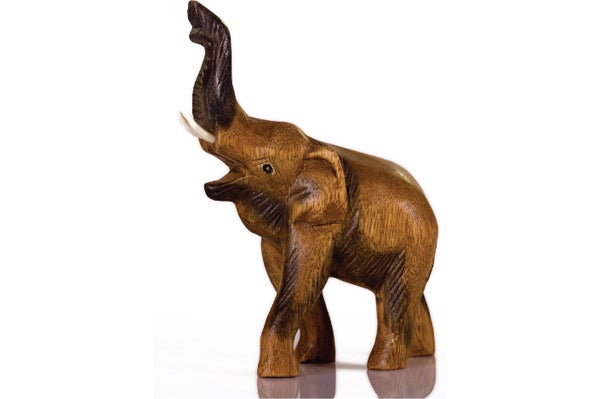
“There are so many virtuous things we want to do that we don't follow through on,” says behavioral scientist Todd Rogers of the Harvard Kennedy School of Government. Rogers ran a series of experiments to test what makes a reminder effective, the results of which were published in May 2016 in Psychological Science. In one experiment, participants who said they wanted the researchers to donate a dollar to charity were told to indicate that choice by remembering to pick up a paper clip on their way out of the laboratory. Those who were told to look for a small elephant statue near the paper clips were more likely to follow through. Subsequent experiments showed that the reminder object worked better when it was unusual or unique in its context (for instance, the only stuffed animal on the desk). A reminder picture on a computer screen worked in the same way.
For a reminder to succeed, Rogers says, it has to capture your attention at the moment when you can focus on the task. A string around your finger is always there, so it fails to cue you at the right time. Written reminders may be found at the right time and place, but they are often not distinct from the many other papers around us. If instead you place, say, a plush alien by your door and think, “I will remember to mail that card when I see the alien,” you may be more likely to complete the task.