
April marks the 30th anniversary of the world's worst nuclear power disaster, the explosion and fire at a reactor at the Chernobyl plant in Ukraine, in the former Soviet Union. It forced more than 300,000 people to flee and created a zone tens of kilometers wide where radiation levels remain hazardous to this day.
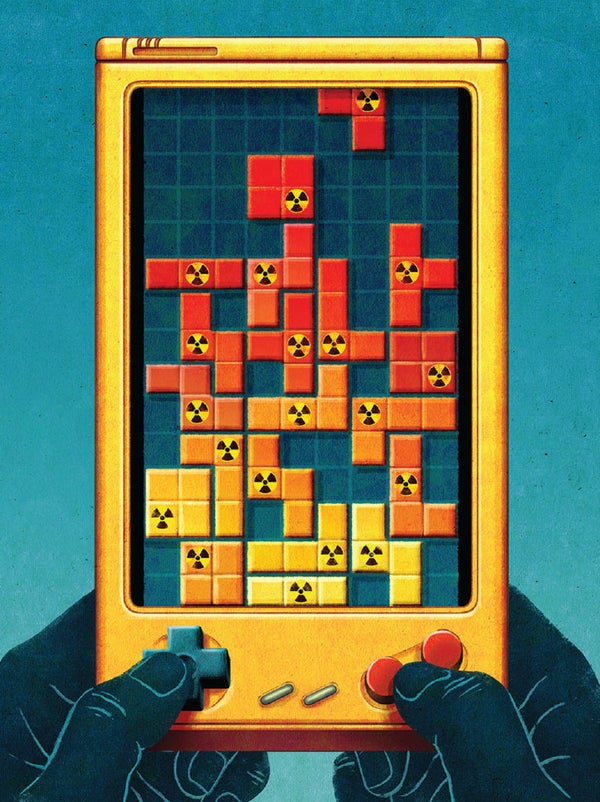
A severe reactor accident is unlikely in the U.S. and other countries with safer facilities. But we face another danger that is in many ways more threatening than a meltdown: the steady accumulation of radioactive waste. The U.S. has dithered over this clear and present danger for decades, irresponsibly kicking the can down the road into the indefinite future.
The spent fuel produced by nuclear power plants will emit harmful radiation for hundreds of thousands—even millions—of years. Some 70,000 metric tons of it are now stored at 70 sites scattered across 39 states. One in three Americans lives within roughly 80 kilometers of a storage site. The waste, hot from radioactive decay, is held in deep pools of water or in “dry casks” of concrete and steel that sit on reinforced pads. Accidents or terrorist attacks could drain the pools or crack the casks, with the risk that the exposed waste could catch fire, spreading radioactive soot across the surrounding countryside and into food chains in a Chernobyl-like catastrophe. As the years go by and waste is packed into overcrowded pools and pads, that risk will only grow.
On supporting science journalism
If you're enjoying this article, consider supporting our award-winning journalism by subscribing. By purchasing a subscription you are helping to ensure the future of impactful stories about the discoveries and ideas shaping our world today.
An acceptable solution to this unacceptable state of affairs has been in the works for more than 30 years. The Nuclear Waste Policy Act of 1982 established a framework for the permanent disposal of the nation's nuclear waste, leading to the 1987 selection of Yucca Mountain, a barren peak in the high desert of Nevada, as the site of a deep geologic repository that would be built and operated by the Department of Energy.
At Yucca, spent fuel housed in steel canisters would be sealed within tunnels above the water table, in a manner meant to minimize corrosion and possible leakage of radioactive material, even over geologically long periods. But because of strident political opposition from Nevadans, as well as vexing scientific uncertainties over the site's geologic suitability, President Barack Obama halted work on the repository in 2010. Today Yucca Mountain's fate remains in limbo. The danger aside, the lack of such a repository also stacks the deck against nuclear power as a viable, low-carbon tool for counteracting climate change.
In the aftermath of Yucca's mothballing, the DOE has pursued a diverse strategy of nuclear waste management that includes tentative plans for consolidated interim storage facilities, tests of deep boreholes as another possible long-term storage technique, and the development of “consent-based” siting protocols to gain support from municipal and state governments. But these measures will take us only so far. Experts agree that a geologic repository remains the only viable long-term solution for disposing of the majority of commercial nuclear waste.
Creating the repository is both scientifically and politically possible. Last year Finland showed this when it approved construction of the Onkalo facility, which is expected to become the first geologic repository for spent fuel when it begins operations in the 2020s. And even in the U.S., the Waste Isolation Pilot Plant (WIPP) in New Mexico currently stores waste from the production of nuclear weapons. (WIPP is neither designed nor approved to store spent fuel.)
Soon a new president will occupy the White House, and there will be a renewed opportunity to address the urgent issue of the U.S.'s nuclear waste. The decision to close Yucca Mountain must be revisited, and the selection and characterization of alternative sites should be aggressively accelerated. In the interim, more spent fuel should be moved from cooling pools to dry casks, which offer better protection against hazards.
Ultimately, if consent-based siting efforts fail, in favor of the common good the federal government must exercise its power of eminent domain to overcome local opposition, creating a deep geologic repository for nuclear waste. Regardless of whether the next president is for or against nuclear power, he or she must act decisively to avoid poisoning our shared future.