
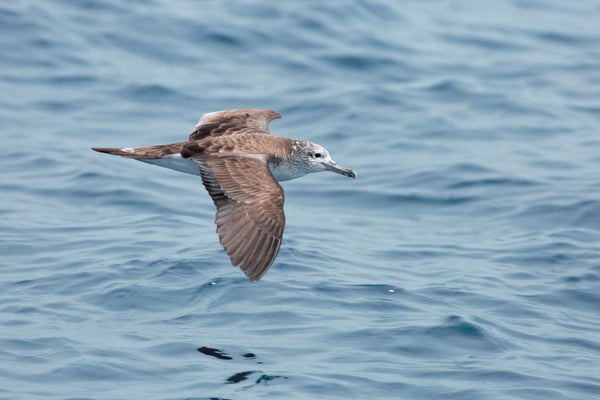
Like big-wave surfers or daring meteorologists, shearwaters in the Sea of Japan deliberately head toward powerful (and dangerous) storms.
When hurricanes strike, most birds either evacuate or take shelter. After all, these storms can cause massive avian mortality. But after analyzing wind data and GPS- tracking information from 75 streaked shearwaters, British and Japanese researchers found that the seabirds sometimes navigate toward the center of hurricanes—and remain there tailing the eye for up to eight hours.
The researchers propose in the Proceedings of the National Academy of Sciences USA that shearwaters do this so they’re not blown ashore, where they are vulnerable to crash landings and predation. The team also found that adult shearwaters handle storms better than juveniles, which lack a “map sense” of where land is.
On supporting science journalism
If you're enjoying this article, consider supporting our award-winning journalism by subscribing. By purchasing a subscription you are helping to ensure the future of impactful stories about the discoveries and ideas shaping our world today.
Swansea University biologist Emily Shepard, a co-author on the paper, says she’s in “awe” of these master fliers—which, like their albatross relatives, use long, thin wings to soar across vast stretches of windswept ocean. (A Manx shearwater once traversed the entire Atlantic Ocean in 12 days, and sooty shearwaters in the Pacific cover up to 40,000 miles a year.)
Shepard’s team found that streaked shearwaters circumnavigated storms when far out at sea. But when sandwiched between a large storm and land—and therefore at risk of being beached—several instead headed right toward the storm’s eye, passing through some of its fastest winds. “Large waves and high winds are not a problem for these birds,” says Josh Adams, a biologist with the U.S. Geological Survey’s Western Ecological Research Center, who was not involved in the study.
Scientists had previously tracked individual albatrosses moving through cyclones, but this is the first time researchers have documented birds appearing to enter storms purposefully and strategically. Despite weighing only as much as a pint of milk, streaked shearwaters “have an inbuilt ability to cope with the strongest storms that Japan’s seen,” Shepard says. “It’s amazing to think” that even during hurricanes, which are projected to increase in intensity because of climate change, “there will be shearwaters out there.”
Other bird species, meanwhile, must flee the scene or risk drowning.