
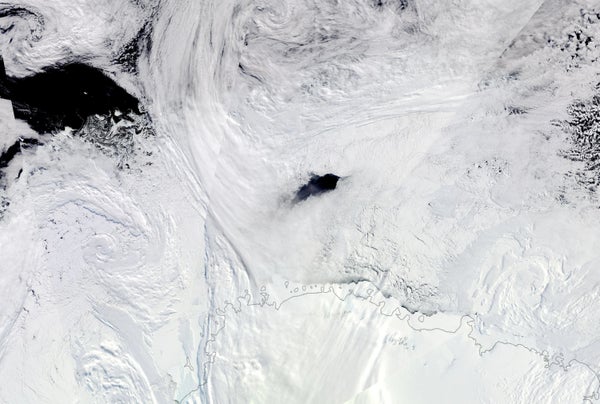
A strange event occurred off the Antarctic coast in the dark midwinter of 2016. A gaping hole opened in the middle of the sea ice on the Weddell Sea, eventually expanding to nearly 13,000 square miles in size. It was the largest ice break observed in that region for decades.
The following winter, another hole formed, this time exposing a whopping 20,000 square miles of ocean water.
Holes in the sea ice, known as polynyas, are observed from time to time in the waters of both the Antarctic and Arctic. They’ve been cropping up in the Weddell Sea every so often for decades, typically over a plateau in the ocean floor known as the Maud Rise, although rarely in such dramatic fashion. Before the 2016 and 2017 events, the biggest polynyas dated back to the 1970s.
On supporting science journalism
If you're enjoying this article, consider supporting our award-winning journalism by subscribing. By purchasing a subscription you are helping to ensure the future of impactful stories about the discoveries and ideas shaping our world today.
The conditions that caused the holes in the first place had remained something of a mystery. Now, scientists believe they’ve figured out what made the last batch—and how these events might be affected by future climate change.
In a new paper, published yesterday in Nature, researchers suggest that a combination of saltier-than-usual water in the Southern Ocean and the influence of strong storms helped open the holes. They used measurements taken by a variety of innovative sources, from robotic floats in the Southern Ocean to deep-diving elephant seals equipped with special sensors, to conduct the study.
Under typical conditions, the water in the Southern Ocean around Antarctica exists in layers, with warmer, saltier water at the bottom of the sea and lighter, fresher water resting on top. But in 2016, sensors revealed that the water near the surface was saltier than usual.
When that happens, there’s less difference between the layers in the ocean, making it easier for them to mix with each other. And when they mix up, warmer layers are able to transfer heat toward the surface of the water, weakening the sea ice.
In 2016, the saltier conditions were likely caused by a shift in the westerly winds, or the winds that blow from west to east, around Antarctica, said lead study author Ethan Campbell of the University of Washington.
“In some years, these winds are closer to Antarctica and they’re stronger, and in other years they’re farther and they’re weaker,” he told E&E News. “Sort of like a tightening of a belt around Antarctica. When they’re closer, it causes upwelling of deep water into the surface layer.”
In keeping with the theory, measurements from floats in the area showed that the region’s sea ice formed unusually late in the season. That means it may have been thinner or weaker than usual.
Next, scientists say, stormy weather likely helped break up the ice and mix up the water. Records show that the 2016 polynya originally formed at the same time a storm swept through the region. Additional storms helped it to expand.
The formation of the 2016 polynya allowed for even further mixing between the ocean layers that primed the region for the occurrence of another, even bigger polynya in 2017, researchers say.
Conflicting climate influences
Fully understanding the formation of events like polynyas can provide scientists with deeper knowledge of the oceanic and atmospheric systems in climate-sensitive regions like the poles. That, in turn, can help scientists evaluate the models they use to simulate physical processes in these regions and make predictions about how they might respond to future climate change.
And being able to predict the formation of polynyas, specifically, could be useful to climate scientists—because they have the potential to affect the climate system themselves, according to Campbell.
For instance, the deep water that upwells to the surface at a polynya can sometimes contain rich stores of carbon that have been sitting at the bottom of the ocean for hundreds or even thousands of years. When that water hits the surface, it may release that carbon back into the atmosphere in a phenomenon known as “outgassing,” Campbell pointed out.
In the same way, winter polynyas may release heat from the upwelling warm water that could also affect the formation of storms or other weather patterns in the Southern Hemisphere, he added.
At the same time, the likelihood that polynyas will form at all may be influenced by human-caused climate change. It’s complicated, Campbell notes, because some effects of climate change may make polynya formation more difficult, and other effects may make it easier.
For instance, melting glaciers on the Antarctic ice sheet release cold, fresh water into the ocean, strengthening the layers in the water and making it more difficult for them to mix up. That’s a process that will likely hinder the formation of polynyas in the long run.
On the other hand, research also suggests that human-caused warming is causing changes in the wind patterns around Antarctica, including a shifting and strengthening of the westerly winds that help mix up the ocean water. Those changes may make polynyas more likely to form in places like the Weddell Sea—and they may be occurring faster, for now, than the freshening of the water caused by the melting ice.
As a result, the researchers say there may be at least a temporary increase in holes and other disturbances in the Antarctic sea ice.
In the long run, though, Campbell notes that these effects are likely to constitute a kind of tug of war between two different sets of climate consequences, and scientists are still working to understand what that will look like in the future.
“We’re not sure which one is going to win out,” he said.
Reprinted from Climatewire with permission from E&E News. E&E provides daily coverage of essential energy and environmental news atwww.eenews.net.