
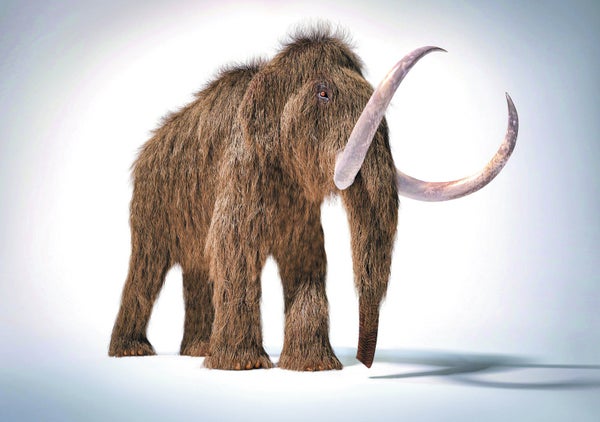
Based on bone and tooth records, the Yukon's last mammoths were thought to have gone extinct about 12,000 years ago. But a new genetic sampling technique suggests the great beasts may have stuck around a lot longer, plodding through the Arctic tundra with bison and elk for thousands of years more. The story is in the soil.
Bones are rich sources of prehistoric genetic information, but not the only ones; items ranging from shed Ice Age skin cells to pine needles can contribute to the genetic record stored in dirt. Paleogeneticists have been extracting and analyzing “environmental DNA” from soil for a long time, but getting rid of non-DNA material without destroying these fragile clues is daunting.
“Environmental samples contain a huge range of other chemical substances that are challenging to separate from the DNA we're interested in,” says McMaster University geneticist Tyler Murchie. “We can't afford to lose whatever we can get.” In Quaternary Reports, Murchie and his colleagues describe gentler techniques that recover up to 59 times as much genetic material as other methods do.
On supporting science journalism
If you're enjoying this article, consider supporting our award-winning journalism by subscribing. By purchasing a subscription you are helping to ensure the future of impactful stories about the discoveries and ideas shaping our world today.
In the new approach, soil samples are extracted with a sterilized chisel and then broken into smaller portions, stirred and run through a “cold spin method” to separate as much DNA as possible. The DNA is then compared against an existing genetic library to detect species matches.
“Not only do these techniques get more DNA, but they get more diverse DNA,” says East Tennessee State University paleontologist Chris Widga, who was not involved in the new study. “It's becoming more nuanced, and it looks like there is actually the potential to document larger slices of the ecosystem.”
This big picture comes from smaller samples, Murchie explains: “With a combination of our novel extraction and enrichment techniques, we can pull out entire genomes of multiple extinct organisms simultaneously from less than a gram of sediment.”
The methodology is limited because researchers using it need to know what DNA to look for. If a saber-toothed cat species is not already in the genetic library, for example, the analysis cannot detect that animal. For known species, however, the process may yield exciting information. In their study, the researchers detected about 2,100 kinds of plants and 180 animals—including American horses and woolly mammoths, in samples from soil dated to thousands of years after their supposed extinction.
Not yet published results from other field sites are yielding similar results, Murchie says, and future fossil discoveries could strengthen the case. “We can use this approach to identify species in places and times we never knew they existed,” he adds, “helping our efforts to find their fossils in places we wouldn't have thought to look.”