
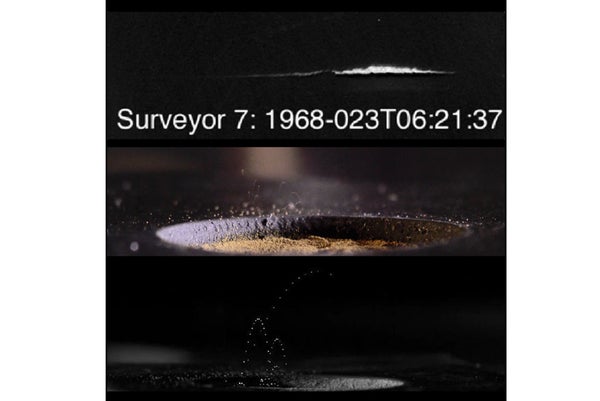
A new study may explain how dust particles on the moon “levitate” just above the surface, even though there is no wind or flowing water on the moon to kick-up the material.
In a recent laboratory study, researchers found that micron-size dust particles could “jump” several centimeters high under ultraviolet (UV) radiation or exposure to plasmas (electrically charged gas), said a statement from NASA. This finding may help researchers better understand how lunar dust is transported across vast regions of the moon and other airless bodies, according to the statement.
“On Earth's moon, these dust particles would have been lofted more than 4 inches (10 centimeters) above the lunar surface, leading researchers to conclude that the moon's 'horizon glow' — seen in images taken by Surveyor 5, 6 and 7 five decades ago — may have been caused in part by sunlight scattering in a cloud of electrostatically lofted dust particles,” NASA officials said in the statement. [Photos: NASA's LADEE Moon Dust Mission in Pictures]
On supporting science journalism
If you're enjoying this article, consider supporting our award-winning journalism by subscribing. By purchasing a subscription you are helping to ensure the future of impactful stories about the discoveries and ideas shaping our world today.
The moon's “horizontal glow” is a slim, bright crescent just above the lunar surface, observed by Apollo astronauts. Scientists think this phenomenon comes from lunar dust particles that scatter light. The recent study builds on previous research and shows that “neighboring dust particles can generate unexpectedly large electrical charges and intense particle-particle repulsive forces,” which lift particles of various sizes off the lunar surface, NASA officials said.
What's more, this electrostatic dust mobilization may help explain the formation of “dust ponds” on asteroid Eros and Comet 67P/Churyumov-Gerasimenko, as well as the smooth surface on Saturn's icy moon Atlas, according to the study published in the journal Geophysical Research Letters.
“This new 'patched charge model' resolved a fundamental mechanism of dust charging and transport, which has been puzzling scientists for decades,” Xu Wang, first author of the study and a member of NASA's Lunar Science Institute at the University of Colorado Boulder, said in the NASA statement. “We expect dust particles to mobilize and transport electrostatically over the entire lunar surface, as well as the surface of any other airless planetary body.”
Copyright 2017 SPACE.com, a Purch company. All rights reserved. This material may not be published, broadcast, rewritten or redistributed.