
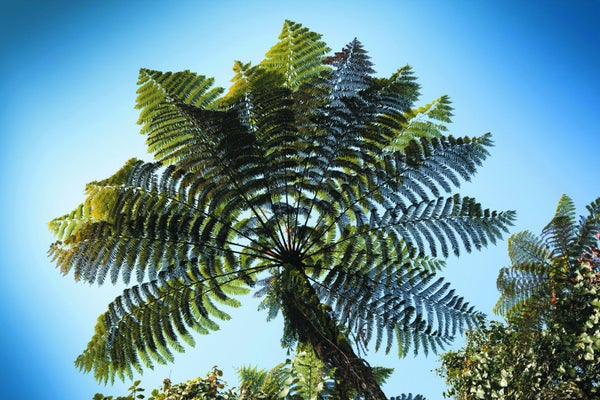
Ferns are weird. They're green and leafy like other forest plants, but they reproduce more like mushrooms do—by releasing clouds of spores. Many species don't require a partner for fertilization, unlike most of their seed-bearing cousins. Recent studies estimate ferns split from seed-bearing plants about 400 million years ago.
And fern genomes are bafflingly large. Despite ferns' unique physiology and their relationship to seed plants, however, these strange genomes have been largely neglected by researchers. Until recently, only two (relatively small) fern genomes were fully sequenced, compared with more than 200 flowering plant genomes. Now the first full tree fern genome has been successfully sequenced—that of the flying spider-monkey tree fern—hinting at how these peculiar plants accrued such a massive set of genes.
“If you want to understand the origin of seeds or flowers, ferns are a very important comparison to make,” says Fay-Wei Li, a fern biologist at the Boyce Thompson Institute at Cornell University and co-author on the new study, published in Nature Plants. “But what I really want to know is why the fern genomes are this damn big.”
On supporting science journalism
If you're enjoying this article, consider supporting our award-winning journalism by subscribing. By purchasing a subscription you are helping to ensure the future of impactful stories about the discoveries and ideas shaping our world today.
Li's team found that the palm tree–shaped fern has more than six billion DNA base pairs, a billion more than the average genome for flowering plants (humans, by comparison, have about three billion pairs). The new analysis suggests that more than 100 million years ago, an ancestor of this fern duplicated its whole genome—a replication error that is common in plants, Li says.
But it is not clear why tree ferns would keep so much genetic material; most flowering plants return to slimmer genomes after duplications. This species might be hoarding chromosomes, Li says: “I call this the Marie Kondo hypothesis. The chromosomes spark joy for ferns, but they don't spark joy for seed plants.” For plants that reproduce asexually, he says, a large genome can add opportunities for beneficial mutations to occur while buffering from undesirable ones. Ferns are also long-lived, so they evolve more slowly, which may have contributed to the retained genetic material.
Using the fully sequenced genome, the researchers also found which genes build the fern's unusual trunklike stem—a valuable insight into how key traits evolved in stemmed plants, says Jan de Vries, a plant evolutionary biologist at the University of Göttingen in Germany, who was not involved in the study. “Evolution is a tinkerer. Illuminating what workable molecular programs have evolved tells us what is biologically possible and where the constraints are,” he says. “Using this knowledge, we can start tinkering ourselves for synthetic biological purposes.”