Strawberry Fields

Nothing is real about the colors you see here

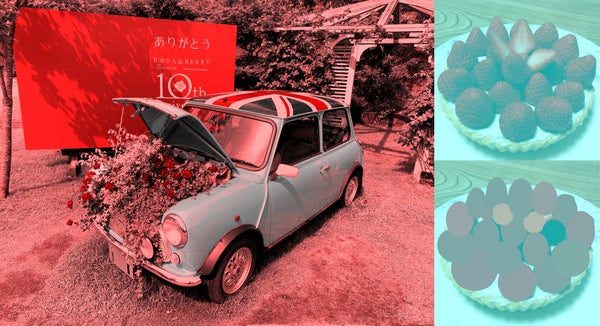
Illusory blues and reds: The car image is composed of red and gray tones. In the fruit plate image, each strawberry is made of tones of gray. Replacing the strawberries with gray blobs does not make them look any less red.

Illusory blues and reds: The car image is composed of red and gray tones. In the fruit plate image, each strawberry is made of tones of gray. Replacing the strawberries with gray blobs does not make them look any less red.

Akiyoshi Kitaoka (left and top right): Michael Bach (bottom right)

Join Our Community of Science Lovers!

Every object we see is a mirror to some extent. The glassy surface of a lake on a windless day is a perfect mirror when it reflects all light faithfully without scatter. But a red strawberry, too, is a mirror, though an imperfect one. The usual reason strawberries appear red is that they reflect reddish and absorb bluish wavelengths. The problem is, sometimes the light that falls on a strawberry does not have any red at all. How do we manage to see red strawberries in the absence of red wavelengths?

In the late 19th century German physiologist Ewald Hering showed that our experience of color is partly the result of our brain interpreting blue as opposite to yellow and red as opposite to green. By the time we perceive a strawberry as red, our perception is far afield from the original light wavelengths. Instead our visual system decides what the surface color of the strawberry probably is based on a process that identifies the light source and then discounts it.

The perceptual consequence of this process is called color constancy because it allows us to see an object’s color as constant, irrespective of the illumination conditions. Because of color constancy, strawberries look red at sunset and at noon, under cloudy skies at your local farmer’s market, and flooded by fluorescent lighting in your supermarket’s produce aisle.


On supporting science journalism

If you're enjoying this article, consider supporting our award-winning journalism by subscribing. By purchasing a subscription you are helping to ensure the future of impactful stories about the discoveries and ideas shaping our world today.


The car photograph, created by vision scientist Akiyoshi Kitaoka with free online software, exemplifies a type of color constancy called the Land effect, after Edwin H. Land, inventor of the Polaroid camera. We see the automobile as blue, but the image contains only red and gray wavelengths.

The plate of strawberries, also created by Kitaoka, illustrates another form of color constancy. Each single berry is actually gray, but your brain begs to differ. Moreover, you do not see the strawberries as red, because you know what color they are supposed to be. Vision scientist Michael Bach modified the original picture by replacing each berry with a gray blob. The resulting image shows that prior knowledge of fruit coloring is irrelevant: even shapeless blobs will take on the color that our visual system assigns them based on our implicit assumptions about the light source.

Susana Martinez-Conde and Stephen Macknik are professors of ophthalmology at the State University of New York and the organizers of the Best Illusion of the Year Contest. They have co-authored Sleights of Mind: What the Neuroscience of Magic Reveals about Our Everyday Deceptions and Champions of Illusion: The Science behind Mind-Boggling Images and Mystifying Brain Puzzles.

More by Stephen Macknik and Susana Martinez-Conde
SA Mind Vol 33 Issue 4This article was published with the title “Strawberry Fields” in SA Mind Vol. 33 No. 4 ()
doi:10.1038/scientificamerican072022-4IYRwTb8MVpWPqVNhOOWNv

It’s Time to Stand Up for Science

If you enjoyed this article, I’d like to ask for your support. Scientific American has served as an advocate for science and industry for 180 years, and right now may be the most critical moment in that two-century history.

I’ve been a Scientific American subscriber since I was 12 years old, and it helped shape the way I look at the world. SciAm always educates and delights me, and inspires a sense of awe for our vast, beautiful universe. I hope it does that for you, too.

If you subscribe to Scientific American, you help ensure that our coverage is centered on meaningful research and discovery; that we have the resources to report on the decisions that threaten labs across the U.S.; and that we support both budding and working scientists at a time when the value of science itself too often goes unrecognized.

In return, you get essential news, captivating podcasts, brilliant infographics, can't-miss newsletters, must-watch videos, challenging games, and the science world's best writing and reporting. You can even gift someone a subscription.

There has never been a more important time for us to stand up and show why science matters. I hope you’ll support us in that mission.

Thank you,

David M. Ewalt, Editor in Chief, Scientific American

Subscribe