
On supporting science journalism
If you're enjoying this article, consider supporting our award-winning journalism by subscribing. By purchasing a subscription you are helping to ensure the future of impactful stories about the discoveries and ideas shaping our world today.
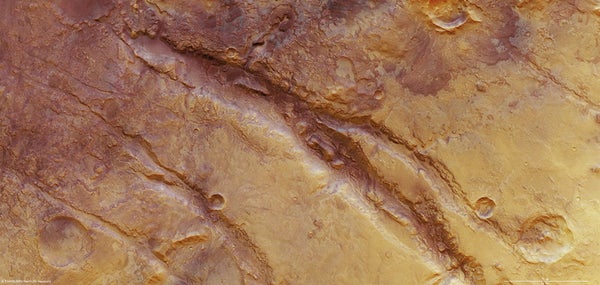
This image of a region of Mars called Nili Fossae was released by the European Space Agency on May 6. In 2009 scientists found high concentrations of methane over the area, but they're not sure of its source—it "could be geological or perhaps even biological," according to the ESA. The agency, along with NASA, plans to launch the ExoMars Trace Gas Orbiter in 2016 to investigate further.
Nili Fossae is located on the northwestern edge of the Red Planet's giant Isidis impact basin. It's a system of concentrically layered troughs, called graben, that are formed between two faults pulled apart by tectonic forces. Scientists think the many faults in the area were created when a projectile hit the Martian surface, leaving behind the 12-kilometer-wide crater seen in the bottom right of the image. After the impact basaltic lava flooded the basin, which caused the ground to sink and stressed Mars's crust, which fractured as it released the pressure.
Many science fiction readers may be familiar with the word graben from Frank Herbert's 1965 novel Dune, where "pan and graben folk" are townspeople, as opposed to the desert-dwelling Fremen who are the stars of the tale. It's engaging to imagine the towns of Herbert's fictional planet Arrakis when looking at real extraterrestrial geologic troughs such as this. Let's just hope there are no sandworms to greet the first human visitors to Mars.
—Francie Diep