
Along with much else, the election in November 2024 was a referendum on the kind of world that voters will provide to future generations, the passing of the baton in a relay race. We had hoped that the American people would seize the opportunity to pass the baton of science to a younger generation—one which would tackle our many urgent problems, including the worldwide threats posed by climate change and potential pandemics.
Regrettably, this turned out not to be the case. Instead, we are now confronted with a federal government that ignores the best-available science. The new administration has mounted a concerted campaign of intimidation, gutting funding for the scientific enterprise and firing thousands of dedicated scientists, among other vital civil servants.
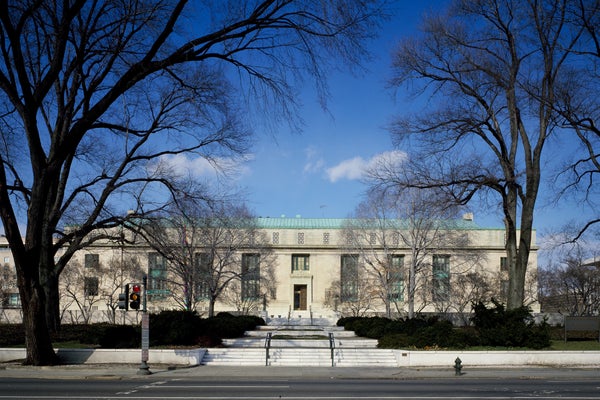
We are deeply concerned, as scientists, that in the face of these concerted efforts to unmake federally funded science, many major professional scientific societies have declined to speak out publicly. We are especially disturbed that the U.S. National Academy of Sciences (NAS), the premier scientific society of the nation, has not yet pushed back against the antiscience policies of the new administration. The NAS has a special responsibility to speak out, having been established by an act of Congress in 1863 as an elected scientific society. It is governed by a 17-member council with an important mission—to provide sound scientific advice to the government. We do not believe that the actions currently taken and proposed by the NAS president, which includes a “working behind the scenes” approach to influence the current administration, according to an e-mail sent to NAS members on February 24, 2025, are an adequate response given the immediacy and seriousness of the harms to U.S. science.
On supporting science journalism
If you're enjoying this article, consider supporting our award-winning journalism by subscribing. By purchasing a subscription you are helping to ensure the future of impactful stories about the discoveries and ideas shaping our world today.
We are proud to be members of the NAS, but we are not proud of its present inaction. In these challenging and defining times, the National Academy of Sciences, of all scientific institutions, must speak up. Thousands of dedicated federal scientists working on critically important issues are being summarily dismissed. These dismissals hurt all Americans—not just those fired. The dismissals make us less safe, less healthy and less aware of how and why the world around us is changing.
In 2016 and 2018, we wrote open letters on behalf of concerned NAS members that highlighted the dangers of ignoring scientific understanding in formulating public policy. We particularly called attention to the central role of science in formulating climate policy, which was being completely ignored by the first Trump administration. The 2018 letter was sent to every U.S. member of the NAS and was signed by 1,220 of them, comprising about 45 percent of all U.S. members. Both letters were grassroots efforts developed by NAS members, without official endorsement by the leadership. The letter writers and signatories were primarily concerned that mature scientific understanding was being incorrectly dismissed as a hoax or conspiracy by powerful politicians, with harmful consequences to all global citizens.
Distressingly, the concerns that prompted the 2016 and 2018 open letters are even more valid today. Since 2018 the evidence for unequivocal human fingerprints on Earth’s climate system has become overwhelming. This evidence is at odds with incorrect claims that human-caused climate change does not exist—or that if it does exist, it is trivially small, or too uncertain, or too expensive to address, or should not be considered in formulating public policy. Infectious disease also became a prominent policy issue during the COVID pandemic, with highly publicized claims that vaccination against COVID widely threatened human health. Such claims had and still have no scientific basis. On climate change, COVID and many other scientific issues, U.S. citizens deserve more accurate information if they are to make informed decisions.
The new Trump administration is now making an unprecedented effort to prevent science from informing public policy. In his first day in office, President Trump signed executive orders withdrawing the U.S. from participation in the Paris Agreement on climate change and from the World Health Organization. The new administration has subsequently acted to drastically limit support for climate and medical research performed by scientists in the federal government and in universities. In this emergency, it is not enough for the National Academy of Sciences to speak up from its grass roots, as in 2016 or 2018. It must now speak as an institution if it is to fulfill its responsibilities to the nation and maintain its relevance in the future. In the 2018 letter we wrote:
“Scientific evidence and research should be an important component of policymaking. We therefore call on the Federal Government to maintain scientific content on publicly accessible websites, to appoint qualified personnel to positions requiring scientific expertise, to cease censorship and intimidation of Government scientists, and to reverse the decision to withdraw the United States from the Paris Agreement.”
We call on the NAS officers and council to endorse these statements without delay, and to call out the recent firings of thousands of federal scientists and the decisions to pause federal funding of critical research. Unless these actions are reversed, U.S. science will not be at the cutting edge of Vannevar Bush’s “Endless Frontier.” His 1945 report coining that term, requested by President Franklin D. Roosevelt, set the U.S. on course for broad support of science to power its prosperity and security.
As we said above, the presidential election in November 2024 was more than just a choice between two candidates or political parties. Some saw it as a referendum on the continued survival of democratic norms and institutions, or as a vote on the health of the economy. Others viewed the election as a referendum on immigration policy, abortion rights, the rule of law, national security, U.S. engagement with the rest of the world, access to affordable housing and health care, vaccination policy, the availability of cheap energy, and how to respond to climate change. Making informed decisions on many of these issues requires a strong scientific enterprise, and a strong voice from scientific leaders.
Otherwise the baton of scientific leadership will have been dropped by the U.S. It will fall to other nations to pick it up and become leaders. Ironically, with all the concern that the present administration has shown concerning U.S. competitiveness with China, the present antiscience policies mean that the U.S. will not lead the race to develop and deploy cheap and efficient low-carbon energy sources to ameliorate climate change and novel vaccines to cope with future pandemics. We will lose capacity not only in climate science, clean energy and infectious diseases, but in many other realms of science and technology. Without a strong scientific enterprise, the U.S. will finish among the “also-rans” for decades to come.
This is an opinion and analysis article, and the views expressed by the author or authors are not necessarily those of Scientific American.