
What happens down on the farm could soon pose bigger problems downriver.
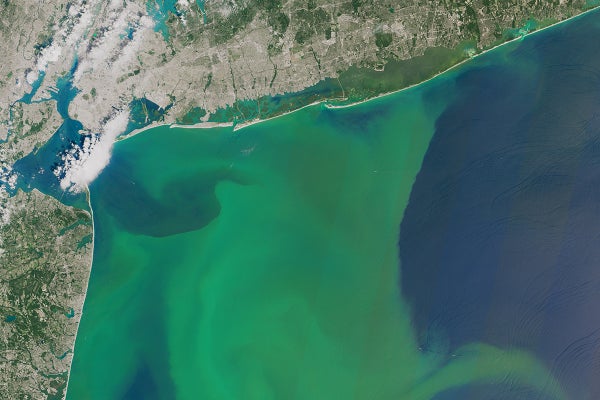
Water undergoes deadly changes when enough fertilizers seep into rivers, lakes and streams. Algae growth explodes, oxygen levels drop and fish either leave the waterway or suffocate. Since the 1970s, large swaths of the Gulf of Mexico have transformed into so-called dead zones — covering an average area about the size of Connecticut — as agricultural runoff filters from the Mississippi River. The Chesapeake Bay and other fisheries have struggled with the problem, too.
Federal and state regulators have been trying for years to limit the Gulf’s dead zone by about two-thirds, to less than 2,000 square miles. Climate change could put that goal even further from reach.
On supporting science journalism
If you're enjoying this article, consider supporting our award-winning journalism by subscribing. By purchasing a subscription you are helping to ensure the future of impactful stories about the discoveries and ideas shaping our world today.
If global greenhouse gas emissions remain steady, more frequent and heavier rains will wash about one-fifth more nitrogen into waterways by the end of the century, according to a study published yesterday in the journal Science.
Farmers, working under U.S. EPA guidelines, are already trying to cut their nitrogen runoff by 20 percent. That takes a 32 percent reduction in how much nitrogen they put into their farmland.
Meeting EPA’s goal under heavier rains would take even steeper cuts. Farmers would have to reduce their nitrogen use by as much as 62 percent, according to the researchers, Eva Sinha and Anna Michalak of the Carnegie Institution for Science and Venkatramani Balaji of Princeton University.
The researchers found nitrogen levels are likely to spike most in the Northeast, the Great Lakes Basin and the Upper Mississippi/Atchafalaya River Basin, which covers 31 states and part of Canada.
India, China and Southeast Asia are also likely to see spikes in nutrient-saturated water, known as eutrophication.
Precipitation remains one of the most difficult aspects of climate change to predict. But the researchers seem to have accounted for the topic’s inherent uncertainty, said Phil Arkin, a longtime climate researcher at NOAA who now works as deputy director of the Earth System Science Interdisciplinary Center at the University of Maryland.
The researchers conclude that the changing weather patterns could, at best, negate existing strategies for reducing nitrogen in the waterways or, at worst, compound the problem as land use intensifies.
Those results highlight the urgency of reducing nitrogen pollution — even if the path forward is expensive and technologically challenging, Sybil Seitzinger and Leigh Phillips wrote in a commentary also published by Science. Seitzinger is executive director of the Pacific Institute for Climate Solutions, and Phillips is a journalist and author.
“In the energy sector, humanity needs to perform one action: Stop burning fossil fuels,” the researchers wrote. But farming poses a more difficult challenge. “There is no alternative to eating,” they wrote.
Nitrogen use efficiency has already improved 36 percent for corn and 30 percent for Asian rice, Seitzinger and Phillips wrote. And Denmark has halved its nitrogen output without decreasing its farm yields.
“But in such places, the lowest-hanging fruit has been picked,” they wrote. “Further reductions require greater expense and technological innovations.”
Reprinted from Climatewire with permission from E&E News. E&E provides daily coverage of essential energy and environmental news at www.eenews.net.