
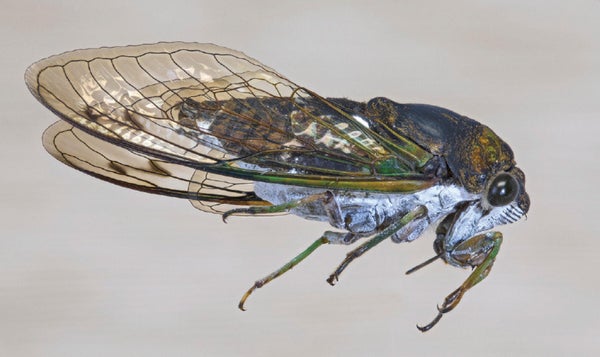
Nature often inspires engineering. Cicada wings, for example, have long tantalized researchers with their water-repellent and antimicrobial properties, which would be useful to replicate in manufactured products. But previous studies involved totally removing the wings' surface chemicals, sometimes damaging the wings and giving an incomplete picture of how those chemicals work together with the wings' structure. New research investigates substances coating cicada wings layer by layer, revealing a complex interplay between topography and chemistry.
Researchers analyzed two cicada species that each have a highly ordered pattern of tiny, conelike structures called nanopillars on their wings. Previous work suggested nanopillars contribute to the insects' ability to shed water and help kill microbes.
To avoid wing damage, the team tested a method called microwave-assisted extraction that had not been used on intact insect wings before, says Jessica Román-Kustas, an analytical chemist at Sandia National Laboratories. Román-Kustas is lead author on the new study, which appeared in May in Advanced Materials Interfaces. The method involved heating and cooling wings immersed in chloroform and methanol, analyzing layers of chemicals as they came off. “It [was] days of sitting at the microwave with a timer and a computer,” she says.
On supporting science journalism
If you're enjoying this article, consider supporting our award-winning journalism by subscribing. By purchasing a subscription you are helping to ensure the future of impactful stories about the discoveries and ideas shaping our world today.
In both cicada species, the researchers found that the nanopillars' chemical makeup is important for maintaining structural integrity. “When you remove the outer [chemical] layers from the nanopillar, the pillars become shorter and bend toward each other,” says Marianne Alleyne, a biologist at the University of Illinois at Urbana-Champaign and a senior author on the study.
In the annual cicada Neotibicen pruinosus, this wilting effect was more extreme and made the wings less water-repellent at first (although they recovered some of that ability as more chemicals were removed). Bacteria-killing activity actually increased as the first layers were removed but then decreased again as more compounds were stripped. The team found that the cicada Magicicada cassinii, which emerges every 17 years and has shorter nanopillars, has surface chemicals that by themselves seem to have bactericidal properties—suggesting these cicadas rely more on their chemical components than structure to kill microbes.
“It is clear … that different layers serve different purposes,” says Terry Gullion, a physical chemist at West Virginia University, who was not involved in the study, “and the ability to probe only specific layers is very important [to obtain] a much better understanding of the overall physical properties' dependence on chemical makeup.”
Understanding how chemicals do (or do not) affect structure may help scientists engineer better products. “By having this fundamental knowledge about how structure and chemistry relate to each other,” Alleyne says, “we can design new materials more rationally, making choices about the structure and chemistry … based on what we have observed in nature.”