
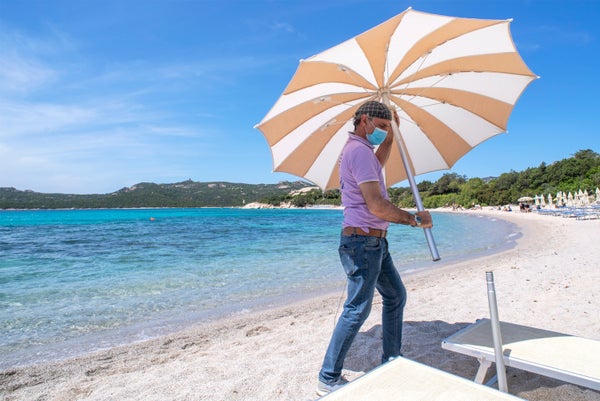
Six months into the COVID-19 pandemic, and with summer on the doorstep, scientists are still investigating whether weather and climate affect the novel coronavirus.
Experts seem to be converging on a mix of good and bad news. Hotter, more humid weather probably does dampen the transmission of the virus, at least a bit. But it’s probably nowhere near enough to significantly affect the progress of the pandemic.
That’s dismal news for U.S. states that have retreated from social distancing protocols—some without robust testing and tracing programs, and many with infection rates still climbing. Broadly, Americans have resumed many facets of their pre-pandemic lives.
On supporting science journalism
If you're enjoying this article, consider supporting our award-winning journalism by subscribing. By purchasing a subscription you are helping to ensure the future of impactful stories about the discoveries and ideas shaping our world today.
Adding to the concerns are mass demonstrations against racism and police brutality. While the protests are widely supported by Americans—including many public health experts—epidemiologists are nonetheless concerned they may boost the risk of COVID-19 transmission.
The public should not assume it’s safe just because it’s warm outside, said Mohammad Jalali, a researcher at Harvard Medical School who’s been investigating the links between weather and the coronavirus.
“All the [public health] interventions and practices should remain in place,” he told E&E News. “And in fact, in anywhere we see major reductions [in the coronavirus], it’s mainly because of all these policies.”
A number of recent studies have suggested summer weather does have some effect on transmission, although the evidence in some cases is shaky. A report published by the National Academies of Sciences, Engineering and Medicine in March, and updated in April, reviewed much of the research to date.
Several laboratory experiments have suggested higher temperatures and humidity are associated with reduced survival of the virus. That said, the report noted, conditions simulated in the lab don’t always mimic conditions the virus will encounter in real life.
The report also pointed to several studies mapping the spread of the virus across the world and compared its progress with local climate variables. Some of these studies also suggested the virus may transmit best within a certain temperature and humidity range.
But these studies also had their shortcomings, the report pointed out—namely, limited data and a relatively short study period since the start of the pandemic.
The report concluded that weather may play a small and likely limited role in the progress of the pandemic in the coming months. Besides temperature and humidity, it noted, “there are many other factors besides environmental temperature, humidity, and survival of the virus outside of the host, that influence and determine transmission rates among humans in the ’real world.’"
Since the report was updated, several more studies have come to similar conclusions.
One new study, published last week by the Journal of the American Medical Association’s open network of online journals, examined the pandemic’s global spread between January and early March. It attempted to address some of the limitations of previous studies.
It found the virus tended to spread within a relatively narrow climate envelope, favoring regions with low humidity and average temperatures between about 40 and 50 degrees Fahrenheit.
The study concluded that the early spread was “consistent with the behavior of a seasonal respiratory virus.”
Since then, however, the disease has spread throughout much of the world, including many areas well outside the narrow climate band identified in the study.
According to lead study author Mohammad Sajadi, a researcher at the University of Maryland School of Medicine, the study wasn’t meant to suggest the virus could only spread within certain climate conditions. Other variables, such as population density and social distancing protocols, have a big effect.
Rather, the study points out the kinds of conditions most likely to affect the risk of transmission, in combination with these other factors, Sajadi said.
Another recent project, a collaboration among a number of research institutes, has tracked the way temperature, humidity and other environmental variables have affected the spread of COVID-19.
The research was published in a working paper, but it has not been subject to peer review. That means the findings are still pending critique by other scientists, and shouldn’t be considered final.
But the analysis, in its current form, does broadly support what other experts have suggested: that weather does have some effect on COVID-19 transmission, but that it won’t have a large effect on the pandemic.
In particular, the study suggests higher temperatures and increased exposure to ultraviolet radiation from sunlight may modestly reduce the disease’s transmission. But Jalali, the Harvard researcher and one of the co-authors, cautioned that they really do mean modestly.
Across nearly 4,000 locations analyzed in the study, the largest effect the researchers observed was a 30% to 40% reduction in transmission associated with weather. That sounds like a lot, Jalali said. But in most locations, even a 40% reduction would still leave COVID-19 cases climbing at an exponential rate.
And such a large effect is only seen with very hot, very humid conditions anyway, he added.
Forecasts are pointing toward a hotter-than-average summer. But on the whole, experts agree it’s no reason to relax vigilance when it comes to the pandemic.
A hot summer could slightly enhance the effect of stringent social distancing, testing and tracing protocols, and other public health interventions. On the other hand, if these measures are relaxed, a spike in COVID-19 cases is likely—regardless of the weather.
That’s already been observed where state reopenings have coincided with a surge in infection rates. At least 14 states have hit an all-time high this month in their rate of new COVID-19 cases.
On the flip side, countries in the Southern Hemisphere could see an increase in the rate of transmission as winter sets in. But, again, it’s probably “not really much” compared with the effect of public health interventions and other variables, Jalali noted.
Over the last few months, many experts have pointed out that the first year of a new epidemic is often unpredictable. That’s because the public has no built-up immunity, and infections tend to rip through the population at breakneck speed.
If the coronavirus really is influenced by weather, as the research suggests, it’s possible it may exhibit more seasonal cycles in the future. But even that is hard to predict, experts say. The way COVID-19 behaves in the future also depends strongly on future public health policies, including any potential vaccines.
“Society, and the way decisionmakers are responding to the pandemic, is changing over time,” Jalali said. “What is going to happen in two or three years is a big question.”
Reprinted from Climatewire with permission from E&E News. E&E provides daily coverage of essential energy and environmental news at www.eenews.net.
Read more about the coronavirus outbreak from Scientific American here. And read coverage from our international network of magazines here.