
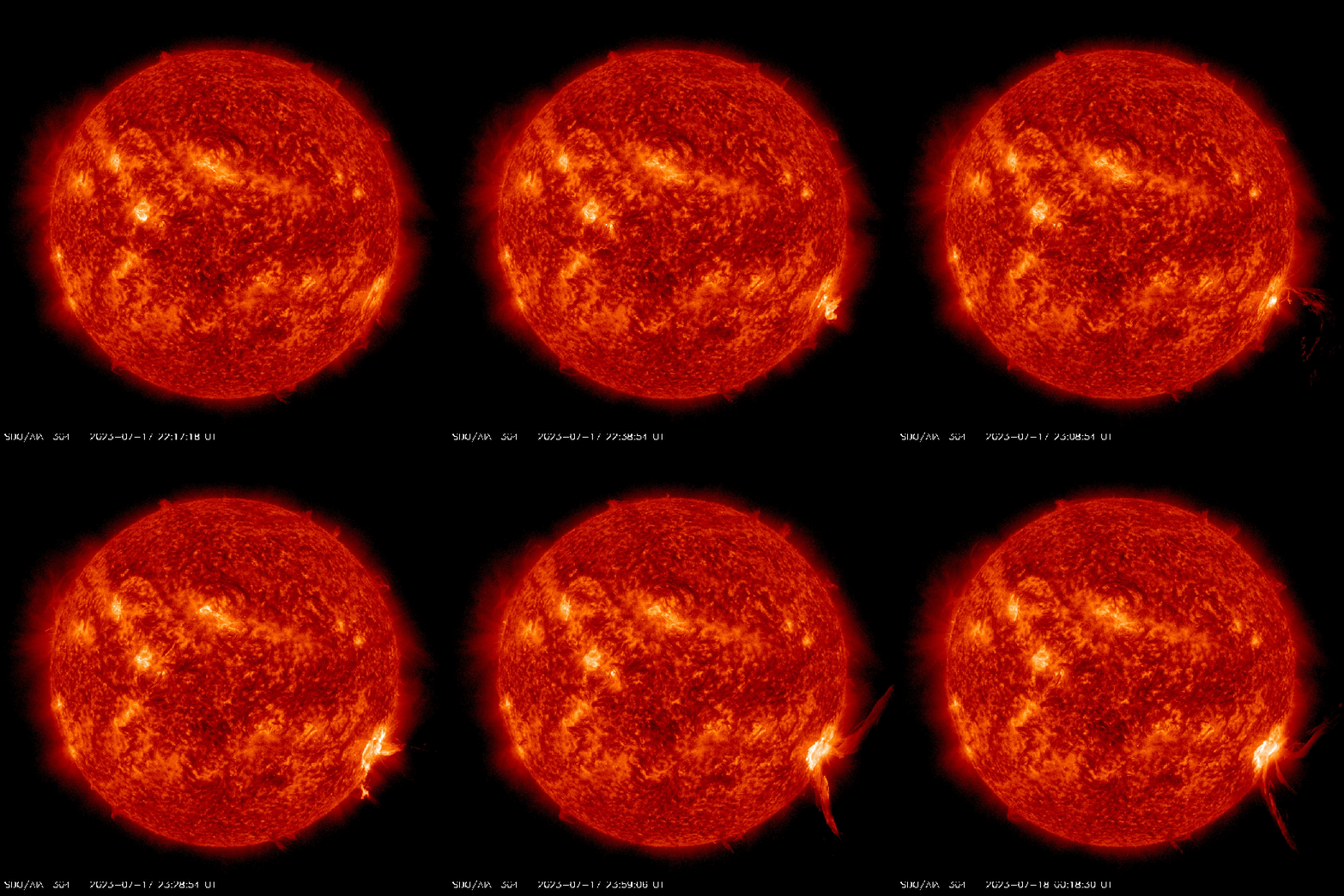
The sun is producing fireworks—letting off a trio of solar flares in just two hours amid a period of high activity that may cause mild consequences on Earth.
Late July 17 and early July 18, the sun let off three of what scientists call M-class flares. (Solar flares are bursts of radiation from the sun and are categorized by their strength. X-class are the most powerful, followed by M-class; C, B and A-class flares are each progressively 10 times weaker.) According to SpaceWeather.com, the third and most powerful flare’s X-ray production remained at M-class levels for nearly four hours.
The event also produced a moderate solar radiation storm, which occurs when Earth’s magnetic field channels protons from the sun through our planet’s atmosphere near the poles, according to the National Oceanic and Atmospheric Administration (NOAA) Space Weather Prediction Center. The solar radiation storm is interfering with some high-frequency radio transmissions, which is a common hazard during such events.
On supporting science journalism
If you're enjoying this article, consider supporting our award-winning journalism by subscribing. By purchasing a subscription you are helping to ensure the future of impactful stories about the discoveries and ideas shaping our world today.
The standout flare also produced a coronal mass ejection (CME), flinging a giant bubble of charged particles called plasma out into space. Because the radiation emitted by solar flares travels at the speed of light, it reaches Earth quite fast, but CMEs and other flare-produced material travels more slowly through space. Scientists expect this particular trailing outburst will reach Earth’s neighborhood on July 20, although the plasma blob isn’t expected to make a direct hit on our planet.
All this drama comes from a feature known as AR3363 (the AR is short for active region). AR3363 first became visible earlier this month and is currently located near the 4 o’clock position on the sun’s face as seen from Earth. Soon it will rotate out of view.
The sun’s activity waxes and wanes in an 11-year pattern known as the solar cycle. Scientists track this activity by the number of visible sunspots. During solar minimum, months can pass with no sunspots visible.
The current Solar Cycle 25 began in December 2019 when activity was low. The sun is expected to reach solar maximum in 2025 before its activity fades again.
In June scientists monitored 163 sunspots, according to NOAA. This solar cycle’s activity has been noticeably above forecasted predictions that this solar cycle would see a similar level of activity as the last solar cycle, which peaked in 2014.
Solar activity can interfere with satellite communications, air travel infrastructure and the power grid, among other vital aspects of modern life, so scientists are eager to better understand and predict the range of phenomena they call space weather, which includes solar flares, CMEs, and more.