
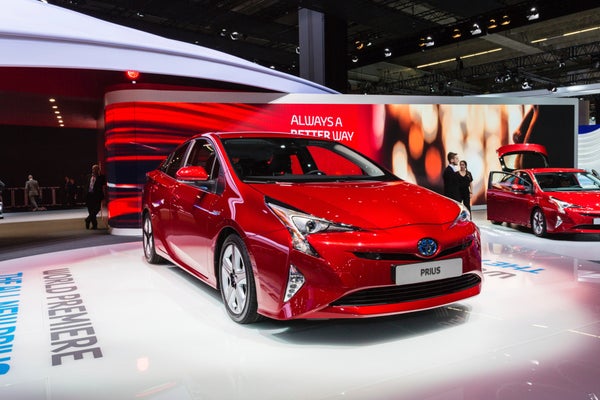
Four robbers rushing out of a bank find their getaway car towed and decide to instead hop into ... a Toyota Prius. In the 90-second commercial that aired during this weekend’s Super Bowl, the new Prius Four dashes down the highway in an hourslong car chase. It even power slides.
The focus on performance is a departure for the Prius, a car beloved by environmentalists but at times criticized for being boring. Experts say the ad represents a wider shift as more clean vehicles hit dealerships.
To reach new customers, automakers are increasingly developing, and marketing, the non-green aspects of fuel-efficient cars.
On supporting science journalism
If you're enjoying this article, consider supporting our award-winning journalism by subscribing. By purchasing a subscription you are helping to ensure the future of impactful stories about the discoveries and ideas shaping our world today.
“There’s been an opportunity to shift the brand a little. We’re not abandoning the fuel efficiency and environmentalism,” said Doug Coleman, national manager for advanced vehicle technology marketing at Toyota.
“The new Toyota next-generation architecture basically meant we could layer on top of those known qualities for a Prius a fun-to-drive mechanic, dynamic and stylish,” he said.
Previous Prius ads have included more traditional natural imagery. Swaying human figures dressed as grass, trees and clouds starred in the iconic “Harmony Between Man, Machine and Nature”commercial, for example.
Since the Prius’ debut as the world’s first mass-produced hybrid vehicle in the early 2000s, it has become the best-selling hybrid in the United States. But it is no longer the only one.
Many other automakers have developed their own models, from the Ford Fusion to the Chevrolet Volt. Those can start to rival the Prius’ high fuel efficiency, which used to be its main selling point. Electric vehicles from Tesla Motors Inc. and Nissan Motor Co. Ltd. have hit the market with a promise of zero gasoline use. Plug-in hybrids and fuel-cell vehicles have also joined the mix.
Hybrids remain the main alternative-fuel vehicle that new customers consider, according to Autotrader Inc. polls, and the Prius still dominates that category. Sales of the Prius hit a high point of 236,655 in 2012 before falling to 184,794 for 2015, according to figures from automotive sales and research company TrueCar Inc. cited in the Los Angeles Times.
“Now you have a bunch of options, it’s a question of how do you differentiate your car. By adding that extra attitude or sportiness, it gives it an extra selling point,” said Brian Moody, executive editor at Autotrader. “Now, there’s a little of something for the new customer.”
In a $2-a-gallon world, mpg is no longer king
The Super Bowl spot calls the new Prius “Heck on wheels” and stars actors from the HBO series “The Wire.” It’s a little tongue-in-cheek: There’s a farmer’s market. Police dispatchers at first dismiss the Prius’ speed but quickly reconsider. The car outlasts police cars, which have to stop to refill their gasoline engines. Later, in electric mode, it swerves silently past sleeping policemen on the highway.
Toyota Motor Corp.’s current CEO, Akio Toyoda, used to be a race car driver and has sought to make all of Toyota’s cars more “exciting.”
The new Prius is the first built on the lighter-weight Toyota New Global Architecture, which gives it a more rigid body. It looks different, with a lower center of gravity—which Toyota promises will make it more fun to drive. Its city mpg could reach around 55, a 10 percent improvement.
Searches for the Toyota Prius spiked 313 percent on Kelley Blue Book following the commercial, making it the third-most visited model on KBB.com among cars in Super Bowl advertisements.
The ad also comes at a time when oil prices are plummeting, reaching below $2 a gallon. Hybrids and electric vehicles sales fared poorly in 2015 compared to SUVs and trucks. Autotrader polls from October 2012 to May 2015 show that new purchasers of the Prius say their primary reason was gas mileage, at 52 percent.
“People are not buying as much for the high mpg,” Coleman said. “There’s certainly a segment that is buying for the best fuel efficiency possible, and I think we’ve locked that group up, but there’s a lot of people who are out there and just really want a car that is fun to drive, and built for me as a driver.
“It’s a buyer that you can’t speak to with the message of sacrifice. It should be both, it should be great to the environment and great for me,” he said.
Last year, a Super Bowl ad for BMW’s i3 electric car played on the newness of the concept. Katie Couric and Bryant Gumbel starred in a pair of scenes, talking respectively about the newness of the Internet in 1994 and the newness of the i3 in 2015. The tagline: “Big ideas take a little getting used to.”
A 2012 Nissan Leaf advertisement featured a polar bear fleeing a melting Arctic.
“I don’t know if we would see that now in an electric car ad,” said Karl Brauer, a senior analyst at Kelley Blue Book.
The anticipated Chevrolet Bolt, an electric vehicle with a driving range of 200 miles, has been previewed as fun to drive and powerful.
“As much work as has gone into selling environmentally conscious cars, they are only having a minor impact, because people thought there were too many other compromises,” Brauer said. “You’ve gotten to the point where you can’t sell green cars purely as green cars; you have to sell them as a good car that also has green benefits.”
Reprinted from Climatewire with permission from Environment & Energy Publishing, LLC. www.eenews.net, 202-628-6500