Supercomputer unravels core-collapse supernovae

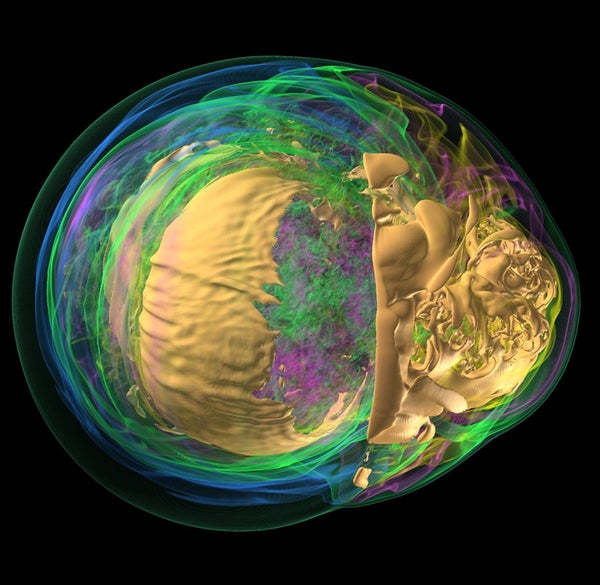
Kids, don't try this on your home computer. The U.S. Department of Energy's Argonne National Laboratory developed this model of an exploding star's core to help elucidate what happens inside core-collapse supernovae.

Argonne National Laboratory via Flickr (Creative Commons license); Image courtesy Hongfeng Yu

Join Our Community of Science Lovers!


On supporting science journalism

If you're enjoying this article, consider supporting our award-winning journalism by subscribing. By purchasing a subscription you are helping to ensure the future of impactful stories about the discoveries and ideas shaping our world today.


Kids, don't try this on your home computer. The U.S. Department of Energy's Argonne National Laboratory developed this model of an exploding star's core to help elucidate what happens inside core-collapse supernovae. The model was made using the lab's IBM Blue Gene/P machine, currently ranked seventh on a list of the world's most powerful supercomputers. Argonne's Blue Gene/P boasts more than 160,000 processors, as many as would be found in Giants Stadium were it filled to capacity with people toting dual-core laptops.

"In astrophysics, studying how stars burn and explode pulls together all kinds of physics: hydrodynamics, gravitational physics, nuclear chemistry and energy transport," Mark Hereld of the Argonne Leadership Computing Facility said in a press release. To take on such a massive task, Argonne's computing team developed a method for creating graphic visualizations of data on Blue Gene/P without bouncing the data to graphics processors, which can be cumbersome.

Studying complex problems such as the mechanics of a supernova "often lead[s] to questions that are very complicated to pose mathematically," Hereld said. "But when you can simply watch a star explode through visualization of the simulation, you can gain insight that's not available any other way."

It’s Time to Stand Up for Science

If you enjoyed this article, I’d like to ask for your support. Scientific American has served as an advocate for science and industry for 180 years, and right now may be the most critical moment in that two-century history.

I’ve been a Scientific American subscriber since I was 12 years old, and it helped shape the way I look at the world. SciAm always educates and delights me, and inspires a sense of awe for our vast, beautiful universe. I hope it does that for you, too.

If you subscribe to Scientific American, you help ensure that our coverage is centered on meaningful research and discovery; that we have the resources to report on the decisions that threaten labs across the U.S.; and that we support both budding and working scientists at a time when the value of science itself too often goes unrecognized.

In return, you get essential news, captivating podcasts, brilliant infographics, can't-miss newsletters, must-watch videos, challenging games, and the science world's best writing and reporting. You can even gift someone a subscription.

There has never been a more important time for us to stand up and show why science matters. I hope you’ll support us in that mission.

Thank you,

David M. Ewalt, Editor in Chief, Scientific American

Subscribe