
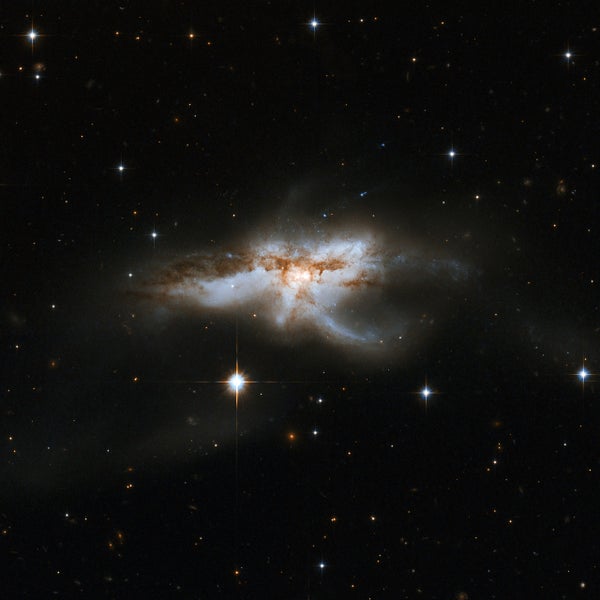
For the first time, astronomers have observed the final stages of galactic mergers, peering through thick walls of gas and dust to see pairs of supermassive black holes drawing closer together and the black holes’ rapid growth.
At the centers of most, if not all, galaxies are supermassive black holes with masses that are millions to billions of times that of Earth’s sun. For instance, at the heart of our Milky Way galaxy lies Sagittarius A*, which is about 4.5 million solar masses in size.
Previous work found that mergers of galaxies might help fuel the growth of supermassive black holes. That research suggested that black holes at the cores of colliding galaxies may combine to become even larger black holes. [When Galaxies Collide: Photos of Great Galactic Crashes]
On supporting science journalism
If you're enjoying this article, consider supporting our award-winning journalism by subscribing. By purchasing a subscription you are helping to ensure the future of impactful stories about the discoveries and ideas shaping our world today.
Galactic mergers likely give supermassive black holes ample opportunities to rip apart stars and devour matter. Such destruction releases extraordinary amounts of light and likely serves as the driving force behind quasars, which rank among the brightest objects in the universe.
However, support for the merger-based model of the growth of supermassive black holes has proven mixed, the new work’s authors said. While some research has shown a link between quasars and merging galaxies, other studies have found no such association.
One possible explanation for the apparent lack of a link between quasars and merging galaxies is that gas and dust swirling around these galaxies is likely to heavily obscure the black holes. This would be true even during the early stages of mergers, when the galaxies are separated by more than 16,000 light-years of space. Computer simulations suggest that such concealment peaks during the final stages of mergers, when galactic cores are less than 10,000 light-years apart, the study authors said.
Now, the researchers have observed several pairs of galaxies in the late stages of merging, their core supermassive black holes pulling closer. The findings shed light on how even more-massive black holes might come about.
The scientists first searched for hidden black holes by sifting through 10 years’ worth of X-ray data from NASA’s Neil Gehrels Swift Observatory. When black holes devour matter, such “active” black holes can generate high-energy X-rays visible even through thick clouds of gas and dust.
Next, the researchers looked for galaxies matching these X-ray finds by combing through data from NASA’s Hubble Space Telescope and the Keck Observatory in Hawaii. Deformable mirrors controlled by computer, a technology called adaptive optics at the Keck Observatory help sharpen images of stars, “leading to a huge increase in resolution,” study lead author Michael Koss told Space.com. Koss is an astrophysicist at scientific research company Eureka Scientific in Oakland, California.
“It would be like going from 20/200 vision, where you are legally blind, to 20/20 vision, helping us see galaxies in incredible detail,” he said.
Credit: M. Koss (Eureka Scientific, Inc.)/NASA/ESA;Keck images: M. Koss (Eureka Scientific, Inc.)/W.M. Keck Observatory; Pan-STARRS images: M. Koss (Eureka Scientific, Inc.)/Panoramic Survey Telescope and Rapid Response System
All in all, the scientists analyzed 96 galaxies observed with the Keck Observatory and 385 galaxies from the Hubble archive. All of those galaxies are located an average of 330 million light-years from Earth, relatively close by in cosmic terms, with many similar in size to the Milky Way.
The researchers found that more than 17 percent of these galaxies hosted a pair of black holes at their centers, signs of the late stages of a galactic merger. These findings matched the researchers’ computer simulations, which suggested that highly active but heavily obscured black holes hidden within gas- and dust-rich galaxies are responsible for many mergers of supermassive black holes.
“Galactic mergers might be a key way of growing black holes,” Koss said.
Our own Milky Way galaxy is currently undergoing a merger with the neighboring Andromeda galaxy, and the supermassive black holes at the two galactic cores will eventually smash together, Koss said.
“Right now, the galaxies are separated by millions of light-years, but we’re moving toward Andromeda at 250,000 mph [400,000 km/h],” Koss said. “In 6 billion years, there will be no Milky Way galaxy or Andromeda galaxy — just one big galaxy.”
An even better view of mergers in dusty, heavily obscured galaxies may come from NASA’s highly anticipated James Webb Space Telescope, slated for launch in 2021. Improved images could also come from adaptive-optics systems in the next generation of very large ground-based telescopes, such as the Thirty Meter Telescope, the European Extremely Large Telescope and the Giant Magellan Telescope, Koss said. The James Webb Space Telescope should also be capable of measuring the masses, growth rates and other physical features for each member of nearby black hole pairs, according to the researchers.
The new work was detailed online today (Nov. 7) in the journal Nature.
Copyright 2018 Space.com, a Future company. All rights reserved. This material may not be published, broadcast, rewritten or redistributed.