
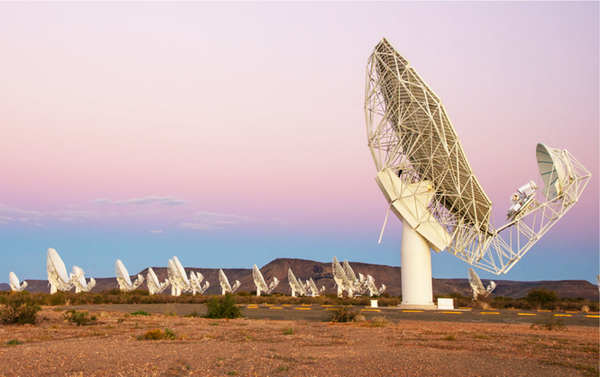

Nations involved in the Square Kilometre Array (SKA)—a project to build the world’s largest radio telescope—have signed a convention to establish an intergovernmental organization to oversee the project and formally approve its construction.
The body, called the SKA Observatory, will be similar to organizations such as CERN, Europe’s particle-physics laboratory near Geneva, Switzerland, and will replace the SKA Organization, which has managed the telescope’s design and pre-construction activities since its establishment in 2011. The observatory, which is set to be headquartered near Manchester, U.K., will have greater authority than the organization and will award contracts for the array’s construction.
The powerful telescope will be built in phases, and will ultimately comprise thousands of radio dishes in Africa and up to a million antennas in Australia. Together, these will have a receiving area of one square kilometre, and will be able to detect faint radio signals from the early Universe.
On supporting science journalism
If you're enjoying this article, consider supporting our award-winning journalism by subscribing. By purchasing a subscription you are helping to ensure the future of impactful stories about the discoveries and ideas shaping our world today.
In the first, €674-million (U.S.$760-million) phase, 130,000 antennas will be built in Australia, and more than 130 dishes will be added to South Africa’s 64-dish MeerKAT telescope, the project’s test bed. Construction is expected to begin in late 2020 and to take about seven years.
Twelve countries are currently involved in the project, but only seven—Australia, Italy, South Africa, the Netherlands, the United Kingdom, Portugal and China—signed the convention on 12 March as founding members. Sweden and India are also expected to sign up as full members.
The signing of the convention is an impressive achievement, given the diverse countries involved and the absence of historically influential science nations such as Russia and the United States, says Peter Gluckman, a science-diplomacy specialist and chair of the International Network for Government Science Advice in Auckland, New Zealand.
Before the observatory is formally created, signing nations must ratify the convention in their parliaments, which could take up to a year. Non-founding member countries will have to go through a separate accession process to join the observatory as full members.
This article is reproduced with permission and was first published on March 12, 2019.