
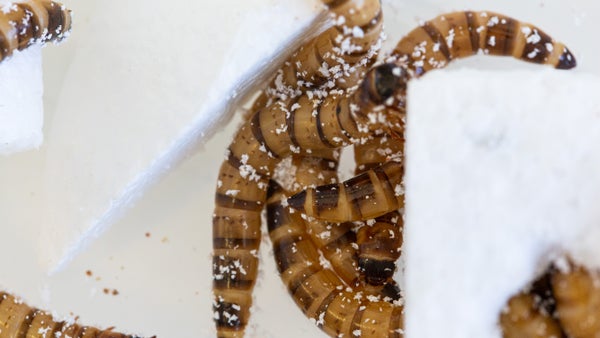
One of the noticeable things about microbiologist Christian Rinke’s laboratory is the startlingly loud crunching noise of wormlike larvae chewing their way through polystyrene, burrowing into blocks of the plastic foam. Before he discards a chewed-through block, Rinke says he raises it to his ear to check for stragglers. “If the worm is still eating in there,” he says, “you can actually hear it.”
Rinke and his colleagues have been feeding plastic to Zophobas morio beetle larvae—dubbed “superworms”for their large size—to see if the microbes and enzymes in their gut might offer insights into how to break down some of the staggering amount of plastic waste humans generate. The researchers have found that these superworms can survive on a diet of nothing but polystyrene, which is used in a vast array of products, ranging from cups to packing peanuts. The worms’ ability to process the plastic suggests it is very efficiently broken down in the creatures’ digestive tract. “They are basically like eating machines,” says Rinke, who works at the University of Queensland in Australia and co-authored a new study describing his team’s findings, published on Thursday in Microbial Genomics.
On supporting science journalism
If you're enjoying this article, consider supporting our award-winning journalism by subscribing. By purchasing a subscription you are helping to ensure the future of impactful stories about the discoveries and ideas shaping our world today.
To investigate how superworms’ gut microbiome reacts to a purely plastic diet, the researchers split 135 of the creatures into three groups: one was fed only wheat bran, another was fed only soft polystyrene, and the third was given nothing. All the worms were monitored for cannibalism, and members of the starved group were isolated from one another. The bran-fed larvae were significantly healthier than their plastic-fed or starved counterparts, more than doubling their weight over the three weeks they were monitored. After that, some of the worms from each group were set aside to grow into beetles. Nine out of 10 bran-fed worms successfully grew into beetles and maintained the most diverse gut microbiome of all three groups. The plastic-fed larvae made less impressive gains—but they still put on more weight than the starved worms, and two thirds of them grew into beetles. Clearly polystyrene is a poor diet for the larvae, Rinke says. But it seems they can extract at least some energy from the material.
This is likely because of a symbiotic relationship between a superworm and its gut bacteria. The worm essentially shreds the plastic so the bacteria can biodegrade it and break it down into smaller molecules that may be more easily digestible—or possibly could one day be upcycled to create new plastic, Rinke says. Knowing exactly which bacterial enzymes these gut microbes use to break down the polystyrene is the golden ticket to replicating the process on a large scale in the future. For the new study, identifying those enzymes required sequencing the genomes of the organisms in the worms’ gut. “Using metagenomics, we can actually characterize all the genes in the [digestive] microbiome,” Rinke says. Previous studies of other insects were not as comprehensive, focusing on just one or two possible gut bacteria or enzymes, according to Rinke.
Uwe Bornscheuer, head of the biotechnology and enzyme catalysis department at the University of Greifswald in Germany, has been waiting for these kinds of data since it first became evident just more than a decade ago that some insect larvae could eat hard-to-degrade plastics—and could thus possibly help scientists find a way to use biodegradation to recycle them. The newly published work is “the first solid study where they looked into the metagenome,” says Bornscheuer, who was not involved with the paper but had been following this area of research.

Polystyrene in the gut of a Z. morio beetle larva. Credit: The University of Queensland
Rinke and his colleagues identified specific enzymes that they thought acted in a particular order to biodegrade the polystyrene in the superworms’ gut. But Bornscheuer has pointed out to the team that, in the order in which the researchers had placed those enzymes, they could not break the notoriously strong bonds between carbon atoms in the plastic. Based on that feedback, the researchers are now revising the steps they proposed: they will include the same enzymes later in the process.
Rinke and his colleagues are not suggesting that superworms should be released into landfills or polluted landscapes to munch through mountains of plastic—but rather that the worms’ unique gut microbiome may hold a key to developing a chemical process to biodegrade the material. The researchers have their work cut out for them. They plan to use their new study’s metagenomic data as the foundation to experimentally verify what each identified bacterial enzyme does to plastic and how all the enzymes fit together to hopefully find the most efficient way to break down our plastic waste.
