
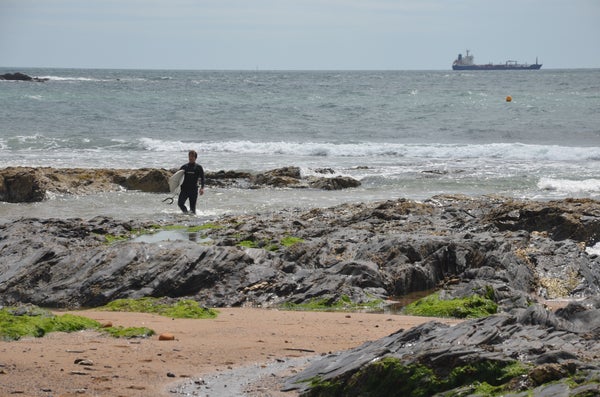
Satellites are good at measuring temperatures over vast stretches of ocean, but less accurate at monitoring a particularly important type of marine environment—coastlines. Now help could come from an unlikely source: a water sports “navy” of surfers, anglers, scuba divers and others. A U.K.-led team of researchers has proposed this alliance to help gather coastal climate data in a recent paper in Frontiers in Marine Science.
The idea follows an influx of useful data collected by scientists who just happen to surf, led by marine remote-sensing researcher Bob Brewin from Plymouth Marine Laboratory (PML) in England. Using the surfboard-laboratories they designed, these researchers have shown satellite-measured water temperatures consistently register 1 degree Celsius too cool along local beaches. That discrepancy is important, because it means authorities may be planning responses to climate change based on measurements that underestimate warming at coastlines—which can be economically and ecologically crucial areas.
“We cannot trust satellite data in the nearshore environment for monitoring long-term trends in sea-surface temperature,” Brewin says. So his team is pushing to create a coalition of volunteer water sports enthusiasts who could gather more close-up data to complement satellite readings. Their results could also help retune measurements from space to be more accurate along coasts. “If we start collecting these data sets now, we can begin to understand how our coastal environment is responding to climate change,” Brewin adds.
On supporting science journalism
If you're enjoying this article, consider supporting our award-winning journalism by subscribing. By purchasing a subscription you are helping to ensure the future of impactful stories about the discoveries and ideas shaping our world today.
Along with surfers skimming and monitoring the surface, the researchers want to get scuba enthusiasts to let their dive computers measure temperatures below, then feed the information into a database. Meanwhile Tim van Emmerik from Delft University of Technology in the Netherlands and colleagues have had interest from wading suit manufacturers for the prototype temperature-sensing boots they designed for anglers. Van Emmerik foresees wearers automatically connecting to a data-collection system, like private weather stations do with Weather Underground.
These sports all take place in areas that are important for marine life but difficult to monitor by conventional means, Brewin says. For example, coastal sea-surface temperature records are poor because crashing breakers smash data-collection buoys and boats. So he and his surfer buddies attached thermometers to the leashes linking them to their boards. They use these sensors, together with GPS receivers in waterproof packs under their wet suits, to collect data in the waves.
This approach has already produced some interesting results, according to a study published in September in Estuarine, Coastal and Shelf Science. In it the team compared data collected from Devon’s Wembury and Bovisand beaches between January 2014 and February 2017 against readings logged by satellites and buoys. Despite being much closer than satellites, the two buoys involved were still seven and 33 kilometers away from the beaches. That was too far from the coast to pick up the 1 degree C temperature discrepancy in the satellite data that the surfers’ sensors did.
The study suggests “a unique solution” to problems with satellite-based sea-surface temperature measurements, says Earth scientistGary Corlett at the University of Leicester in England, who was not involved in the research. “Opportunities to increase availability of reference data from recreational water-users should be encouraged,” he adds. Such efforts, like the US-based Smartfin Project, allow people to help protect places they love visiting—and Brewin and his colleagues hope they will eagerly wade into the data-soaked waves.