
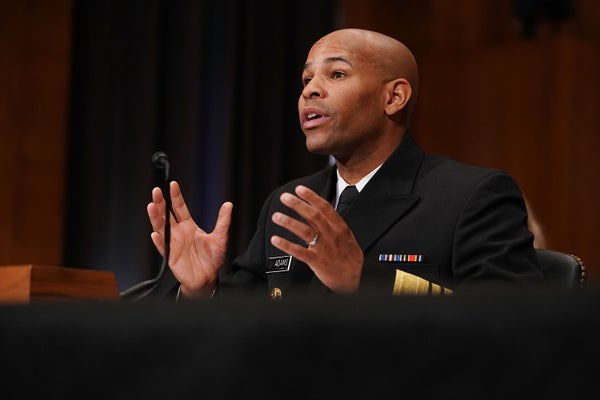
Surgeon General Jerome Adams is issuing a rare public health advisory on Thursday, calling for friends and family of people at risk for opioid overdoses to carry the OD-reversal medication naloxone. He likened the treatment to other livesaving interventions, such as knowing how to perform CPR or use an EpiPen.
The recommendation comes in the form of a surgeon general’s advisory, a tool used to draw attention to major public health issues. The last one, focused on drinking during pregnancy, was issued in 2005.
“What makes this one of those rare moments is we’re facing an unprecedented drug epidemic,” Adams told STAT in a phone interview Wednesday.
On supporting science journalism
If you're enjoying this article, consider supporting our award-winning journalism by subscribing. By purchasing a subscription you are helping to ensure the future of impactful stories about the discoveries and ideas shaping our world today.
Tens of thousands of Americans are dying from drug overdoses each year, largely driven by opioids. While paramedics—and increasingly, police officers—carry naloxone, they often arrive too late for it to save someone’s life. In countless cases, family members and friends—often other people using drugs—have reported using naloxone to save an overdose victim, and the idea is that if more people have naloxone on hand, more people could be saved.
“It’s easy to use, it’s lifesaving, and it’s available throughout the country fairly easily,” Adams said.
States and cities have been working to expand access to naloxone, with many issuing standing orders—essentially blanket prescriptions that cover entire communities—and offering legal protection to people who use the medication. Adams also said that clinicians should consider prescribing naloxone to accompany certain high-dose painkiller prescriptions or for high-risk pain patients, which the Centers for Disease Control and Prevention has recommended.
But the rising price of naloxone, which is available as a nasal spray and an auto-injector, has become an issue. While individuals can typically get it quite cheaply or at no cost through insurance plans or local health departments, or with drug company discounts, some public health agencies have warned that the medication is accounting for an increasing and unsustainable chunk of their budgets, both because of the cost and how many overdoses they are responding to. First responders sometimes have to use multiple doses of naloxone because of the potency of synthetic opioids, such as fentanyl and carfentanil.
Adams said he, as well as President Trump, is committed to ensuring that the price of naloxone does not prevent anyone from getting it. He said that some of the money dedicated to opioids in the recent government-spending bill would be distributed to agencies to help purchase naloxone, and that he had been in talks with naloxone manufacturers, including Kaleo and Adapt Pharma, about pricing and access.
Some experts and advocates, however, have called on the Trump administration to go further, raising the idea of federal health officials negotiating a lower price for naloxone or even sidestepping patents.
In the advisory, Adams identified several groups of people at elevated risk of overdoses, including people who misuse prescription opioids, those who use drugs like heroin and illicitly manufactured fentanyl, and those who have recently left treatment programs or incarceration. The latter groups are particularly vulnerable because they return home with often dramatically reduced tolerance to opioids.
Adams will speak about the advisory in Atlanta on Thursday at the National Rx Drug Abuse and Heroin Summit. Kellyanne Conway, who is spearheading the White House’s opioid efforts, spoke at the summit Wednesday, as did National Institutes of Health Director Francis Collins, who unveiled new efforts to come up with scientific solutions to the crisis.
In the interview, Adams said that his wife, Lacey, who underwent surgery last week for a recurrence of metastatic melanoma, is awaiting pathology results before they decide what’s next for her treatment. The Adamses, who have three children, have posted on social media about Lacey’s cancer as a way to raise awareness about the importance of sun protection to prevent skin cancer.
“She’s doing as well as can be expected, and the kids are hanging in there,” Adams said.
Republished with permission from STAT. This article originally appeared on April 5, 2018