
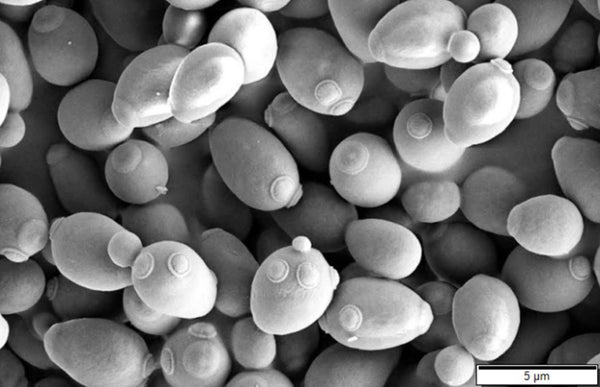
Maciej Maselko has made wild sex deadly—for genetically modified organisms. A synthetic biologist at the University of Minnesota in Minneapolis–St Paul, Maselko and his colleagues have used gene-editing tools to create genetically modified yeasts that cannot breed successfully with their wild counterparts. In so doing, they say they have engineered synthetic species.
“We want something that’s going to be identical to the original in every way, except it’s just genetically incompatible,” says Maselko, who is due to present his work on January 16 at the annual Plant and Animal Genome Conference in San Diego, California. The research was co-led by Michael Smanski, a biochemist at the University of Minnesota.
The technology could be used to keep genetically modified plants from spreading genes to unmodified crops and weeds, thereby containing laboratory organisms, the researchers hope. It might even help combat pests and invasive species, by replacing wild organisms with modified counterparts. Other scientists say that the approach is promising, but warn that it could be stymied by technical hurdles, such as the ability of modified organisms to survive and compete in the wild. “This is an ingenious system and, if successful, could have many applications,” says evolutionary biologist Fred Gould of the North Carolina State University in Raleigh.
On supporting science journalism
If you're enjoying this article, consider supporting our award-winning journalism by subscribing. By purchasing a subscription you are helping to ensure the future of impactful stories about the discoveries and ideas shaping our world today.
Self-destruct mode
Maselko and Smanski used the CRISPR–Cas9 gene-editing tool not to edit target genes, but to alter their expression. The team guided the Cas9 enzyme to over-activate genes so that their protein products accrued to toxic levels. When they first tested the approach in brewer’s yeast (Saccharomyces cerevisiae), they raised the levels of a protein called actin to the extent that the cells containing it exploded.
To prevent genetically modified yeast cells from mating successfully with other strains, the team engineered two modifications to the yeast cells: one, analogous to a ‘poison’, produced a version of Cas9 that, in concert with other factors, recognized and over-activated the actin gene. The second modification, the ‘antidote’, was a mutation that stopped Cas9 from overexpressing actin.
A yeast strain that contained both poison and antidote produced healthy offspring when mated with a strain carrying the antidote. But when the modified strain was crossed with a different lab strain lacking the antidote, almost all of their offspring popped like balloons, Maselko and Smanski’s team reported in Nature Communications in October.
This week, Maselko is due to discuss the team’s progress towards engineering a synthetic species of fruit fly, using a developmental gene called wingless as a poison. Work will soon commence in plants, mosquitoes, nematodes and zebrafish, says Maselko, who, with Smanski, has applied to patent the approach.
A counter to invasion
A synthetic species could also be used to outcompete and control undesirable species that spread disease or harm ecosystems. In another contribution to the conference, Maselko’s colleague Siba Das, also at the University of Minnesota, is presenting a mathematical model showing how synthetic speciation could combat invasive carp, which has ravaged rivers and lakes in Minnesota and other central US states, by replacing the invasive species.
However, the genetic modifications that stop interbreeding—the poison and antidote—could carry a steep evolutionary fitness cost, says Omar Akbari, a molecular biologist at the University of California, San Diego. The Cas9 enzyme doesn’t always recognize its intended gene and could crank up the activity of other genes. Such ‘off-target effects’ could sap the health of modified organisms. Any impact affecting the organisms' potential wellbeing, Akbari adds, should be easy to detect in lab experiments in fruit flies. “I’m not sure if this is going to generate a fit-enough strain to compete in the wild,” Akbari says.
Gould agrees that it will be difficult to engineer reproductive barriers without incurring evolutionary costs. Scientists could potentially overcome this obstacle by releasing large numbers of modified organisms to increase the odds that a synthetic species will overtake wild organisms. Still, Gould—who is working on other genetic approaches to combating pests—is enthusiastic to see another technology. “I would never want to put all my eggs in one basket,” he says.
This article is reproduced with permission and was first published on January 15, 2017.

