
Last summer the esteemed naturalist E. O. Wilson told the Huffington Post that he fears a nuclear conflagration as a clear and present danger to the planet. A similar-sounding fear has been shared by Donald Trump. “The global warming we should be worried about is the global warming caused by NUCLEAR WEAPONS in the hands of crazy or incompetent leaders!” read a Trump tweet, fired off in 2014 and echoed during his candidacy for president.
The two men made these parallel observations for different reasons. Trump wished to downplay the risks of global warming. Wilson, while acknowledging the longer-term peril of climate change, worried that “some stupid mistake” by a nuclear-armed nation could bring on catastrophe in coming years. On an equal footing, he feared a Trump presidency as an immediate menace but at the time believed the mogul could never be elected.
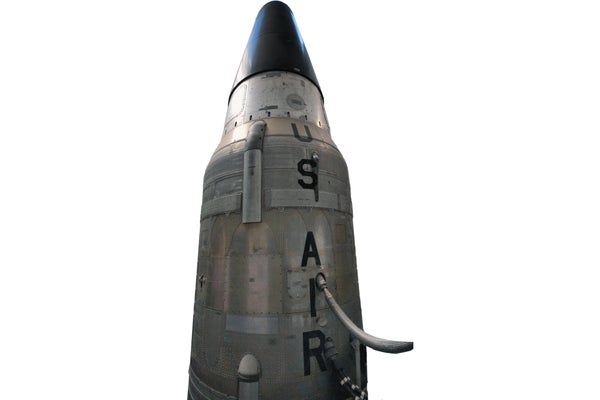
Even before the election, geopolitical tensions had exacerbated the prospects of a nuclear conflict. In fact, the threat posed by nuclear weapons on high alert has persisted for decades. Both the U.S. and Russia hold about 900 nukes ready to launch, a hair-trigger status that keeps submarine- and land-based missiles prepared for immediate firing to deter a first strike—a posture intended to allow these missiles to be launched in retaliation before attacking missiles can hit their targets.
On supporting science journalism
If you're enjoying this article, consider supporting our award-winning journalism by subscribing. By purchasing a subscription you are helping to ensure the future of impactful stories about the discoveries and ideas shaping our world today.
If our early-warning system detects incoming missiles, the president has 12 minutes or less to decide whether to unleash global-scale destruction and take the lives of tens of millions of civilians. So far salvos of incoming missiles have amounted to nothing more than electronic mirages.
Ominously, though, technical glitches have at times fooled both Soviet Union and U.S. warning systems into flagging attacks that were nonexistent. In 1983 a counterattack was averted only when a Soviet military officer decided to trust his gut instinct and concluded that satellite data about incoming U.S. missiles were a false alarm.
The U.S. has experienced its own mishaps. In 1979 computers at the command center in Colorado Springs signaled that a major Soviet nuclear offensive was under way. Both U.S. ballistic missile and nuclear bomber crews sprang into action, only standing down after satellite data could not corroborate the warning. It turned out that data from training software simulating a massive attack had somehow made their way into an operational computer.
The “button” can also morph into a perverse temptation for an unstable leader. In 1974, during his impeachment proceedings, President Richard M. Nixon said to reporters: “I can go into my office and pick up the telephone, and in 25 minutes, 70 million people will be dead.” Worried about Nixon's state of mind at the time, Defense Secretary James Schlesinger asked to be notified before any nuclear launch order from Nixon was executed.
The existential risks of our current policy framework prompted both Barack Obama and George W. Bush to pledge during their first presidential campaigns that they would take measures to move ballistic missiles off high alert. Neither followed through, leaving an opening for the new administration.
After fluctuating wildly from one position to the next on many issues during the 2016 campaign, Trump should give the U.S. electorate some assurance that he intends to govern with a steady hand by making a commitment to take our nuclear arsenal off hair-trigger alert and buy more time to decide whether to push the button.
Trump should adopt a set of pragmatic options that the Union of Concerned Scientists (UCS) and other public-interest groups have outlined, some of which could be readily implemented. Turning a safety switch in the nuclear missile silos, a procedure called safing, used when maintenance workers are on-site, would prevent an unwarranted launch. It would take at least half a day to reverse this process because silos are not staffed, enough time to forestall an irreversible decision.
As the UCS has pointed out, by taking this step unilaterally, the U.S. could reduce the risk of a mistaken or accidental launch that could lead to nuclear retaliation on the U.S. public. It might also serve as a prelude to such measures as removing warheads and storing them elsewhere and ultimately getting rid of the land-based force entirely. The Russians might even be convinced to follow suit. Because of submarines' relative invulnerability, both the U.S. and Russia could be assured of being able to mount a counterattack.
All these moves would make the world safer and might also dissuade China, which does not have its missiles on a hair trigger, from adopting that policy. The need for better preventive steps has also become more acute because of sophisticated cybertechnologies that could, in theory, hack into a command-and-control system to fire a missile that is ready to launch.
Taking the U.S. arsenal off high alert would cost a pittance but could buy enough time to avert the cataclysmic event that once again looms as the most pressing threat to our survival.
JOIN THE CONVERSATION ONLINE
Visit Scientific American on Facebook and Twitter or send a letter to the editor: editors@sciam.com