
Accurately predicting the on-the-ground impacts of climate change remains one of the thorniest challenges facing scientists, regulators, planners and insurers.
But as climate disasters occur with alarming frequency, experts are relying more heavily on predictive technologies that leverage supercomputing and artificial intelligence to identify the where, how and why of climate impacts.
Known as “climate risk analytics,” the delivery of data-based predictive information about risks associated with wind, floods, fires, droughts and other climate disasters is rapidly proliferating, according to experts.
On supporting science journalism
If you're enjoying this article, consider supporting our award-winning journalism by subscribing. By purchasing a subscription you are helping to ensure the future of impactful stories about the discoveries and ideas shaping our world today.
Some of the new analytics firms are highly specialized, tailoring their products to distinct economic sectors, like housing, agriculture or transportation.
Others are taking much larger bites out of the data universe and building dynamic analytical models that can be applied at the community or even regional scale, offering virtual windows into a future altered by climate change.
And it’s happening fast.
“I would say the last two years have represented dramatic change that vastly exceeded even our expectations about how things would evolve,” said Rich Sorkin, chief executive officer of Jupiter Intelligence, a Silicon Valley-based firm staffed by senior scientists and engineers from the U.N. Intergovernmental Panel on Climate Change, NOAA, the National Science Foundation and the National Center for Atmospheric Research.
Industry insiders say supercomputing has eclipsed traditional “catastrophic risk modeling,” whose primary practitioners were banks and property insurers, in many ways. Supercomputing data comes from myriad sources, including weather stations, soil and water sensors, tidal gauges, satellites, cellphone signals, and drones that can feed real-time information to analytics experts on the ground.
“Right now I would characterize it as a situation where if you want to be a fast follower, then you’re still a fast follower,” said James Whitelaw, spokesman for the reinsurance giant Transatlantic Reinsurance Co. “But if you’re not in within five or six years’ time, you won’t be able to catch up.”
Asset managers are also adopting advanced analytical tools to better understand investors’ risks from climate hazards.
BlackRock Inc., for example, recently issued a report in partnership with the Rhodium Group explaining how big data was illuminating climate risks to investors in three key sectors: municipal bond markets, commercial real estate and electric utilities.
Among other things, BlackRock found that the risks of climate change “are especially relevant for physical assets with long lifespans,” adding that “early findings suggest investors must rethink their assessment of vulnerabilities.”
“Climate-related risks already threaten portfolios today, and are set to grow,” BlackRock global chief investment strategist Richard Turnill wrote in a blog post last week.
Origins in Sandy
An early catalyst for the sector’s growth was Superstorm Sandy. The 2012 Atlantic hurricane brought much of New York to a grinding halt as high winds and seawater swept across the city’s boroughs and neighboring New Jersey, reducing the world’s economic capital into a disaster zone that took months to rebuild.
Private- and public-sector entities, especially in New York and California, began talking about data-driven disaster preparedness almost immediately after Sandy. But the work took on heightened urgency following 2017’s record hurricane season, when three major U.S. storms—Harvey, Irma and Maria—caused an estimated $265 billion in damage, including the inundation of much of Houston, the nation’s fifth-largest metropolitan area.
But that wasn’t all.
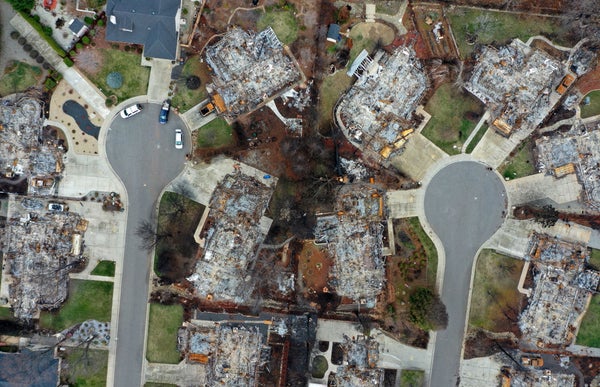
Wildfires consumed millions of acres in California and other Western states in 2017 and 2018, extending the nation’s string of billion-dollar disasters to 45 events between 2016 and 2018.
Among the principal firms pushing climate risk analytics to new heights are Jupiter; Four Twenty Seven of Berkeley, Calif.; and One Concern of Palo Alto, Calif.
Although born of different circumstances and providing distinct products and services, the three young firms share common DNA.
One Concern, launched in 2015 by a team of Stanford University engineering graduate students, has raised $22.6 million in venture capital funding and recently received Fast Companymagazine’s “2019 World Changing Ideas Award” for its “Flood Concern” software platform, besting digital giants eBay, Facebook and Intel.
Following a similar trajectory, Jupiter last month received $23 million in Series B funding from a group of investors. The cash will allow for further expansion and updates to Jupiter’s existing platforms—ClimateScore, FloodScore and HeatScore—while also advancing the release of two new analytics tools, FireScore and WindScore, later this year.
While the insurance sector remains the largest consumer of risk analytics products and services, Sorkin said Jupiter has made significant inroads into other sectors that face both near- and long-term risks from climate events—notably power producers, oil and gas firms, and mortgage lenders.
In an interview, Sorkin said traditional catastrophic risk modeling, such as that used by property and casualty insurers, is based on past losses and year-over-year property valuations. But owners of high-value buildings and infrastructure must calculate their risk profiles over 30 to 50 years, especially when accounting for the risks of climate change.
“If you own a 30-year asset, and you understand that risk is going to be increasing over the life of that asset due to climate change, then your current insurance price is a bad proxy for your future risk,” Sorkin said.
The company’s FloodScore Planning predictive analytics tools have been deployed in some of the nation’s most climate-exposed areas, including New York City, Miami, Houston and the Carolinas.
‘Benevolent’ intelligence
One Concern calls itself a “benevolent artificial intelligence company with a mission to save lives and livelihoods before, during and after disasters.” As such, it has focused its attention on community resilience against hazard risks including earthquakes, fires and floods.
The company’s Flood Concern platform, launched last November, combines the power of machine learning with hydrological and hydrodynamic models to predict floodwater inundation at a block- or even street-level scale—and as much as five days before a hurricane or tropical storm makes landfall.
“The technology has gotten to the point where it’s now practical to say what is the risk for this particular house or this particular hospital. That wasn’t possible 10 years ago,” said Craig Fugate, the former Obama-era Federal Emergency Management Agency administrator who today is One Concern’s chief emergency management officer.
And like Jupiter, One Concern is moving away from traditional modeling techniques that rely on past events to predict future ones.
“One thing that’s driving it is that we’ve always looked at past historical data to make our decisions about risk assessment and risk management,” Fugate said. “But today we’re seeing record-setting events every few weeks, so history doesn’t provide us with a very good sense of what the future is going to look like.”
Reprinted from Climatewire with permission from E&E News. E&E provides daily coverage of essential energy and environmental news at www.eenews.net.