
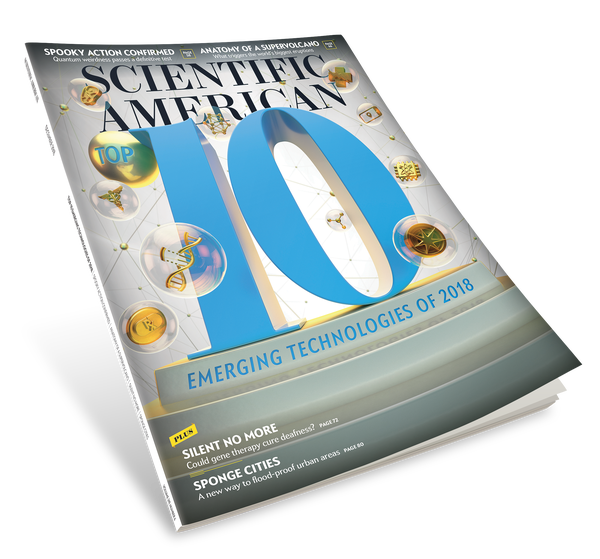
“The advocate of industry and enterprise, and journal of mechanical and other improvements”: that mission visually underscored the logo of our very first issue, dated Thursday, August 28, 1845. In the latest installment of Scientific American's delivery on that promise, we bring you this month's cover story, “Top 10 Emerging Technologies of 2018,” a collaboration between Scientific American and the World Economic Forum's Expert Network.
What's an “emerging” technology? It must be a potentially disruptive solution that is poised to change the world. It must be drawing increasing investment or showing other signs of being ready to erupt globally in the next three to five years. It must offer significant benefits for societies and economies—although our specialist authors don't shy away from noting possible downsides in their articles about each innovation.
The selection process started about a year ago, when we began soliciting great ideas. Each year, we tap Scientific American's editorial team and Board of Advisers, the Forum's knowledgeable networks, and others for nominations. Then a Steering Group of global authorities in multiple fields begins a thorough process of winnowing the list; they further investigate each submission and share insights in the group discussions. Special thanks to our Steering Group and my co-chair Bernard S. Meyerson of IBM, to Rigas Hadzilacos and Oliver Cann of the Forum, and to our many contributors.
On supporting science journalism
If you're enjoying this article, consider supporting our award-winning journalism by subscribing. By purchasing a subscription you are helping to ensure the future of impactful stories about the discoveries and ideas shaping our world today.
For another expert perspective, we turn to quantum physicists Ronald Hanson and Krister Shalm and their feature on “Spooky Action.” The bizarre phenomena of quantum entanglement, where particles can retain a “spooky” connection even when far apart, is challenging to justify against our intuitive picture of nature. The effect has been seen in many experiments—yet each has also contained loopholes that have made it impossible to entirely rule out that any other effect could be at work. At last, they write, loophole-free tests confirm that quantum entanglement can't be explained away.
Dispersed, unconnected bits—this time of fossilized bone—are the problem in “Needle in the Haystack,” by researchers Thomas Higham and Katerina Douka. As the authors describe, in Denisova Cave in Siberia a novel combination of techniques is allowing scientists to comb through large quantities of unidentified fragments for clues about when, where and how human species interacted with one another. Hope you enjoy making the many other science and technology connections throughout the issue; as always, we welcome your thoughts.