
A little over 20 percent of India’s households own an air conditioner or cooler, and fewer than a third have refrigerators—leaving hundreds of millions of people to face rising temperatures without artificial cooling. Extreme heat is estimated to have claimed more than 700 lives in India in 2024, its hottest year on record, and researchers warn that 76 percent of the population faces high to very high heat risk.
But an innovation that’s at least 3,000 years old—terracotta—is emerging as a low-cost, low-energy alternative. Once used by the Bronze Age Harappan civilization to store water, this clay-based ceramic still stands on the shelves of rural Indian homes as earthen pots that cool water without electricity and cost as little as a dollar each.
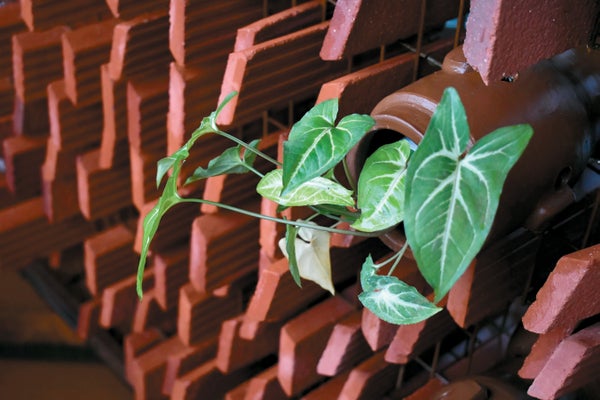
“Terracotta’s porous surface allows water to slowly evaporate, carrying heat away and cooling the space around it,” says Adithya Pradyumna, an environmental health researcher at Azim Premji University in Bengaluru. Drawing on this principle, architects in India’s sprawling metro areas are turning to terracotta for new passive cooling solutions that range from clay refrigerators to perforated tiles, ventilated screens, and facades that allow natural ventilation and help heat and moisture transfer between indoor and outdoor environments. In certain designs, water is also distributed across terracotta surfaces to evaporate and thus lower surrounding temperatures.
On supporting science journalism
If you're enjoying this article, consider supporting our award-winning journalism by subscribing. By purchasing a subscription you are helping to ensure the future of impactful stories about the discoveries and ideas shaping our world today.
Passive cooling uses building design to regulate indoor temperatures with natural materials, strategic ventilation and well-controlled shading. This approach works particularly well in the Mediterranean and other arid or semiarid places— like parts of the Pacific Northwest, where research found it can reduce air-conditioning loads by up to 70 percent.
A pioneer in this field is Delhi-based design company Ant Studio, whose CoolAnt project uses terracotta as a second skin on concrete buildings. “We’ve harnessed its hydrophilic properties and observed average temperature drops of six to eight degrees Celsius across more than 30 sites” in India, says studio founder Monish Siripurapu. The material should be even more effective in drier areas of the country, he adds.
Even such modest temperature drops, Pradyumna says, can “significantly help the human body cool itself more efficiently, especially indoors.” Research shows a direct correlation between rising temperatures and mortality.
Another Indian company, Bengaluru-based A Threshold, is repurposing recycled terracotta into breathable facades. Meanwhile Gujarat-based MittiCool has created clay refrigerators that purportedly keep food fresh for three to five days without power—invaluable in homes without reliable electricity. “Many of our customers can’t afford to run conventional appliances, so this is a durable and affordable alternative,” says MittiCool founder Mansukhbhai Prajapati.
Niyati Gupta, a senior program associate at research institute WRI India, says terracotta “can complement existing cooling systems and reduce our dependence on the fossil-fuel-powered grid. That alone could be a game changer for both the energy and construction sectors.”