
By Julie Steenhuysen
Texas health officials on Monday reported the state's first case of Zika likely spread by local mosquitoes, making Texas the second state within the continental United States to report local transmission of the virus that has been linked to birth defects.
The case involved a woman living in Cameron County near the Mexico border who is not pregnant, the Texas Department of State Health Services said.
On supporting science journalism
If you're enjoying this article, consider supporting our award-winning journalism by subscribing. By purchasing a subscription you are helping to ensure the future of impactful stories about the discoveries and ideas shaping our world today.
Pregnancy is the biggest concern with Zika because the virus can cause severe, life-long birth defects, including microcephaly, in which a child is born with an abnormally small head, a sign its brain has stopped growing normally.
Texas said it currently has no other suspected cases of local Zika transmission, but officials there plan to step up efforts to watch for the virus.
The U.S. Centers for Disease Control and Prevention said it was coordinating with state and local officials to increase surveillance efforts and "vector control activities" such as spraying for adult mosquitoes and applying larvicide to kill emerging mosquitoes.
Texas is one of several U.S. states where Aedes aegypti mosquitoes, which carry Zika, are present.
Florida's Miami Dade County has been battling Zika within local mosquito populations since mid-summer. As of today, the state has had 238 cases of locally transmitted Zika.
“We knew it was only a matter of time before we saw a Zika case spread by a mosquito in Texas,” Dr. John Hellerstedt, Texas Department of State Health Services commissioner, said in a statement.
“We still don’t believe the virus will become widespread in Texas, but there could be more cases, so people need to protect themselves from mosquito bites, especially in parts of the state that stay relatively warm in the fall and winter.”
Dr Amesh Adalja, an infectious diseases expert at the University of Pittsburgh Medical Center, said local transmission in Texas was "totally expected."
Both dengue and chikungunya, two closely related viruses, have already spread locally in Texas, and the state "is a well-established home" of Aedes mosquitoes.
"What this case underscores is the risk of local transmission in any area in which Aedes mosquitoes are present and the urgent need to continue aggressive vector control measures to minimize the impact of such local introductions," he said.
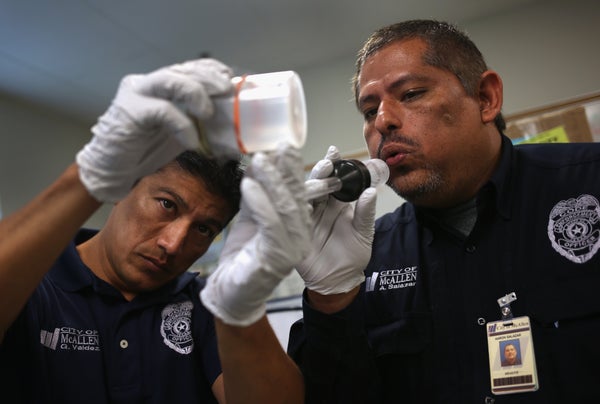
Officials in Cameron County and the City of Brownsville have assessed the woman's home and have begun trapping and testing mosquitoes to understand how widespread the virus is in local mosquito populations.
The city recently sprayed for mosquitoes in the area, and will continue to take action to reduce the mosquito population, state and local officials said.
“Even though it is late in the mosquito season, mosquitoes can spread Zika in some areas of the country,” CDC Director Tom Frieden said in a statement. “Texas is doing the right thing by increasing local surveillance and trapping and testing mosquitoes in the Brownsville area.”
There is no vaccine or treatment for Zika, which causes mild fever, rash and red eyes. An estimated 80 percent of people infected have no symptoms, making it difficult for individuals to know whether they have been infected.
The connection between Zika and microcephaly first came to light last year in Brazil, which has since confirmed more than 2,000 cases of the birth defect.
In adults, Zika infections have also been linked to a rare neurological syndrome known as Guillain-Barre, as well as other neurological disorders.