That Thoroughly-Used-Up Kind of Life

Living your best life doesn’t depend on wealth, or even happiness, but a rich and complex experience

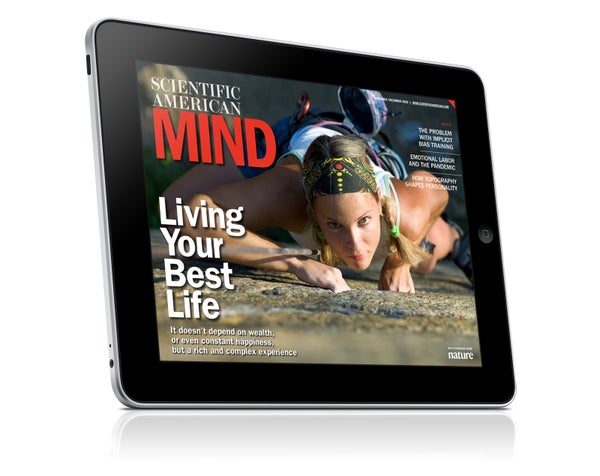
Scientific American Mind November 2020

Scientific American Mind November 2020

Join Our Community of Science Lovers!


On supporting science journalism

If you're enjoying this article, consider supporting our award-winning journalism by subscribing. By purchasing a subscription you are helping to ensure the future of impactful stories about the discoveries and ideas shaping our world today.


Is there anything more American than the pursuit of happiness? Not merely written into the Declaration of Independence, it seems to be one of the more important metrics by which we measure our progress through life. In 2016 I remember reading a fascinating article on Vox.com by Ruth Whippman, a British writer, who made an intriguing observation after having lived in both countries. Americans’ obsession with being happy, and our many efforts to achieve it, she wrote, was in fact making us miserable. Some interesting research backs up the idea that the more you value happiness, the less happy you are.

In this issue’s cover story, Scott Barry Kaufman explores how a psychologically rich life, not necessarily a happy one, might yield a higher return on investment, so to speak. If emotional growth is of value to you, a wide range of feelings, challenges and experiences—even bad ones—might give you the good life you’ve been seeking (see “In Defense of the Psychologically Rich Life”). This is a comforting concept during a time of so much challenge and uncertainty. And it reminds me of a quote from journalist Hunter S. Thompson: “Life should not be a journey to the grave with the intention of arriving safely in a pretty and well preserved body, but rather to skid in broadside in a cloud of smoke, thoroughly used up, totally worn out, and loudly proclaiming “ ‘Wow! What a Ride!’ ”

Andrea Gawrylewski is chief newsletter editor at Scientific American. She writes the daily Today in Science newsletter and oversees all other newsletters at the magazine. In addition, she manages all special editions and in the past was the editor for Scientific American Mind, Scientific American Space & Physics and Scientific American Health & Medicine. Gawrylewski got her start in journalism at the Scientist magazine, where she was a features writer and editor for "hot" research papers in the life sciences. She spent more than six years in educational publishing, editing books for higher education in biology, environmental science and nutrition. She holds a master's degree in earth science and a master's degree in journalism, both from Columbia University, home of the Pulitzer Prize.

More by Andrea Gawrylewski
SA Mind Vol 31 Issue 6This article was published with the title “That Thoroughly-Used-Up Kind of Life” in SA Mind Vol. 31 No. 6 (), p. 2
doi:10.1038/scientificamericanmind1120-2

It’s Time to Stand Up for Science

If you enjoyed this article, I’d like to ask for your support. Scientific American has served as an advocate for science and industry for 180 years, and right now may be the most critical moment in that two-century history.

I’ve been a Scientific American subscriber since I was 12 years old, and it helped shape the way I look at the world. SciAm always educates and delights me, and inspires a sense of awe for our vast, beautiful universe. I hope it does that for you, too.

If you subscribe to Scientific American, you help ensure that our coverage is centered on meaningful research and discovery; that we have the resources to report on the decisions that threaten labs across the U.S.; and that we support both budding and working scientists at a time when the value of science itself too often goes unrecognized.

In return, you get essential news, captivating podcasts, brilliant infographics, can't-miss newsletters, must-watch videos, challenging games, and the science world's best writing and reporting. You can even gift someone a subscription.

There has never been a more important time for us to stand up and show why science matters. I hope you’ll support us in that mission.

Thank you,

David M. Ewalt, Editor in Chief, Scientific American

Subscribe