
Global temperatures will continue to rise over the next decade and will reach a critical milestone in the 2030s, two of the U.S. government’s leading climate scientists said yesterday.
Climate change that made the 2010s the hottest decade in recorded history will persist unabated in the 2020s, and by 2035 will reach a critical level of 1.5 degrees Celsius above pre-industrial levels, the scientists said.
“Notwithstanding some sort of major, major geophysical event, it would be almost certain that the [next] decade will be warmer than the previous. It’s almost certain that we would break one annual record during the process,” said Deke Arndt, climate monitoring chief for NOAA’s National Centers for Environmental Information.
On supporting science journalism
If you're enjoying this article, consider supporting our award-winning journalism by subscribing. By purchasing a subscription you are helping to ensure the future of impactful stories about the discoveries and ideas shaping our world today.
Gavin Schmidt, head of NASA’s Goddard Institute for Space Studies, said the global warming trend line since the 1970s “has been quite close to linear. Extrapolate forward and you would imagine we would cross 1.5 degrees around 2035.”
The Paris climate accord aims to keep global temperatures from rising by 1.5 C or more to avert the worst climate catastrophes, such as rampant sea-level rise and more destructive wildfires, floods and storms. The U.N. Intergovernmental Panel on Climate Change said last year the window to limit warming to 1.5 C will close around 2030.
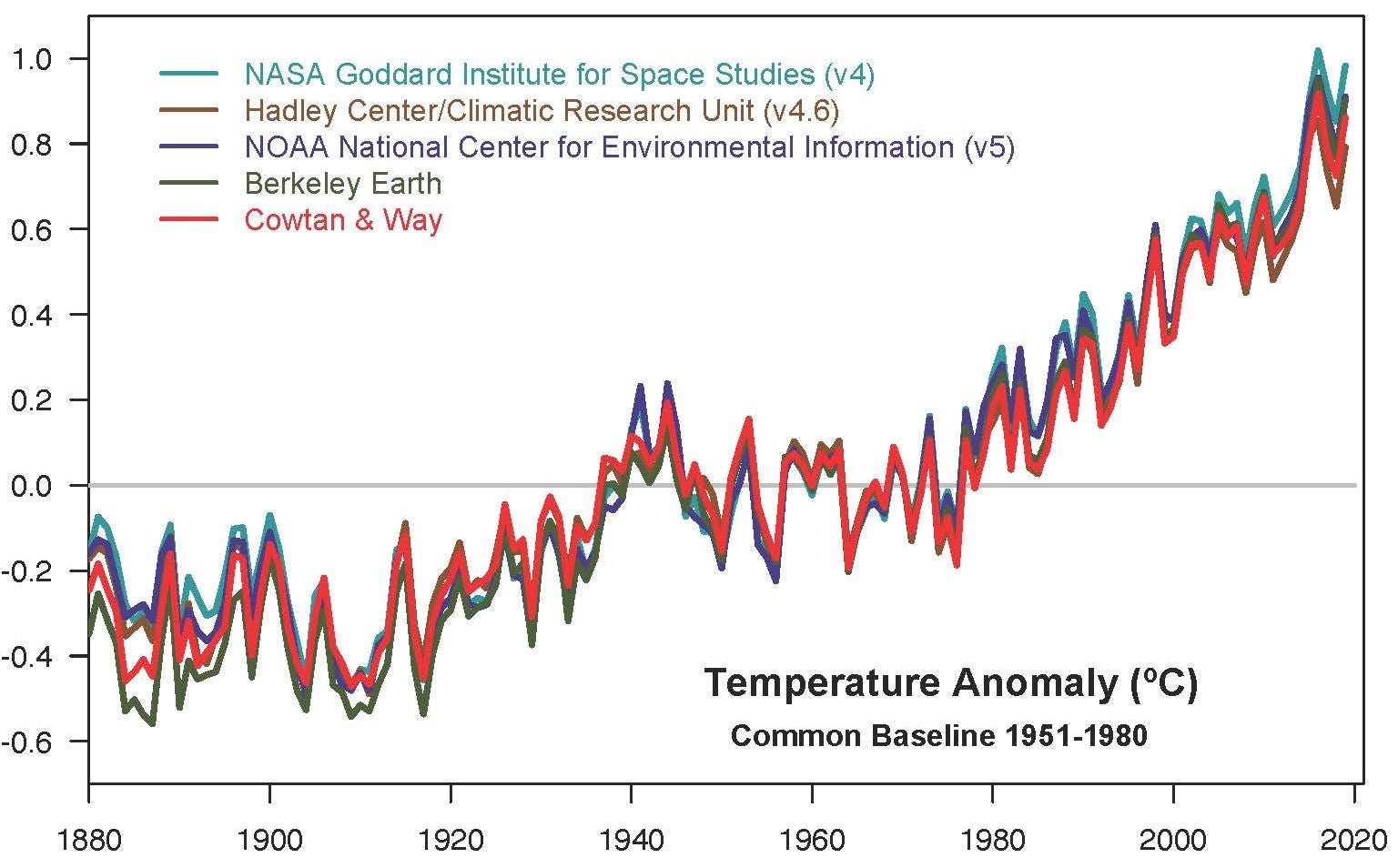
This plot shows yearly temperature anomalies from 1880 to 2019, with respect to the 1951-1980 mean, as recorded by NASA, NOAA, the Berkeley Earth research group, the Met Office Hadley Centre (UK), and the Cowtan and Way analysis. All five temperature records show rapid warming in the past few decades, and all show the past decade has been the warmest. Credit: Gavin Schmidt NASA GISS
Schmidt said the future of global temperatures “depends on what we do with [greenhouse gas] emissions. We aren’t able to tell you by looking at the past how society will react to the information.”
The report yesterday by NASA and NOAA reached a conclusion similar to other climate agencies such as the European Union’s Copernicus Climate Change Service, which said last week that 2019 was the second-hottest year since record keeping began in 1880. The hottest year is 2016.
Arndt and Schmidt highlighted the similarity of five recent studies of global temperature trends to support their findings.
“These are five independent analyses that make different assumptions. It doesn’t really matter which way you cut it, it always looks the same,” Schmidt said. “The fact is the planet is warming. The main thing here is not really the ranking [of 2019] but the consistency of the methodology and the long-term trends that we’re seeing.”
Warming patterns are especially acute in the Arctic, which is heating up three times as quickly as the rest of the planet, Arndt said. At the same time, the amount of sea ice in the Arctic is falling, triggering sea-level rise and contributing to global warming.
The researchers said the recent trends are clearly the result of human-induced climate change caused by rising greenhouse gas emissions.
“Climate change in the past had nothing to do with human activity,” Schmidt said, referring to warming that occurred thousands and hundreds of thousands of years ago due to Earth’s orbit or massive asteroids or volcanic eruptions. “That explanation fails in the 20th century because we know there hasn’t been an asteroid and hasn’t been a massive volcano.”
Reprinted from Climatewire with permission from E&E News. E&E provides daily coverage of essential energy and environmental news at www.eenews.net.
