
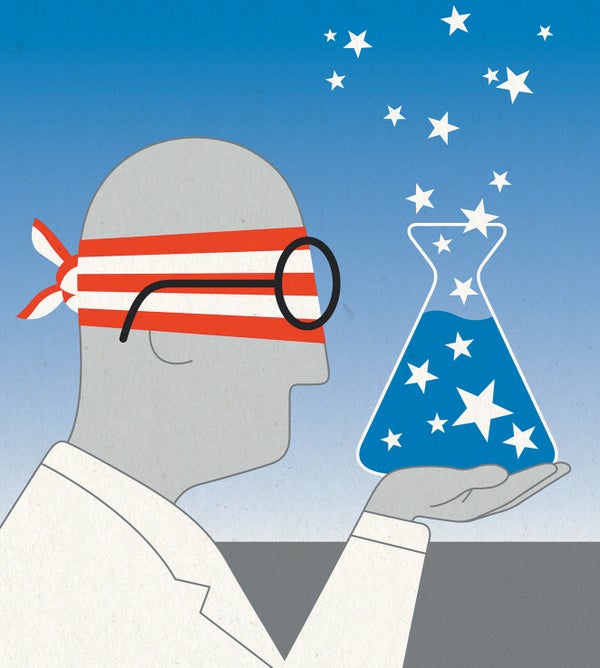
Scientists around the country are nervous as hell. There seems to be a seismic shift happening in Washington, D.C., and our government's relationship with facts, scientific reality and objective truth has never been more strained.
It started with “alternative facts” about the size of the crowd at Donald Trump's inauguration. The White House also asserted, without any evidence, that widespread voter fraud cost Trump the popular vote, even though numerous, bipartisan sources have debunked that claim. My parents' generation would have called such alternative facts falsehoods or even lies. It is not just the peddling of conspiracy theories that is troubling, however. Worse still is that the White House and many members of Congress seem opposed to the very pursuit of facts and have tried to place draconian restrictions on what federal scientists can research, publish or even discuss. And who knows what will happen to our nation's long-standing investments in research and science education?
Science shows us the magnificence of our world. Our oceans hold beautiful coral reefs, bursting with life, gleaming through azure waters. Tropical rain forests teem with creatures, sights and sounds. Here in California we have giant redwoods, reaching skyward, drenched in mist. And off our shores, there are colossal whales, drifting in rich waters, raising their young and singing their ethereal songs.
On supporting science journalism
If you're enjoying this article, consider supporting our award-winning journalism by subscribing. By purchasing a subscription you are helping to ensure the future of impactful stories about the discoveries and ideas shaping our world today.
Through the lens of science, these wonders stir the mind. They awaken our hearts and souls. We instinctively want to share them with the people we love, and preserving them is the greatest gift we can give our children. But science also tells us that these wonders are at risk from widespread habitat loss, pollution and climate change. Science shows us the planet is in trouble, even if many politicians ignore the evidence.
All is not lost, however. Science shows us ways to build a sustainable future—by reinventing our energy system, agriculture and cities. Science can build a future where people and nature thrive together, for generations to come. Ignoring science will doom us to an impoverished, degraded world. Our children deserve better than that, and only science points the way forward.
Ultimately a healthy democracy depends on science. When Congress asked physicist Robert Wilson in 1969 what a new particle accelerator would do to help with national defense, he answered that it would do nothing. The pursuit of scientific truth, he said, “only has to do with the respect with which we regard one another, the dignity of men, our love of culture.” The pursuit of truth, an informed citizenry and the unfettered exchange of ideas are cornerstones of our democracy. They are what make America great. Rejecting evidence and empiricism is a step toward despotism.
There is a long tradition of bipartisan support for science and an evidence-based worldview in the U.S. In fact, the Union of Concerned Scientists has ranked presidents from both parties as exceptional supporters of science, including Abraham Lincoln, Teddy Roosevelt, Harry S. Truman, Richard M. Nixon, Jimmy Carter and George H. W. Bush. Wise leaders have almost always recognized the value of independent science to our democracy.
There is something different about the Trump administration. Something troubling, which scientists need to stand up and call out. While we generally avoid political conversations, scientists should always defend facts, objectivity, and scientific independence and integrity. Not doing so would be almost unethical. So to the Trump administration, I would say this: If your apparent disregard for facts is just a series of missteps, so be it. Say so. Fix it. It would be brave. It would be wise. And it would show some class.
But if this is actually part of your governing philosophy, I would give you a warning on behalf of my fellow scientists: Do not mess with us. Do not try to bury the truth. Do not interfere with the free and open pursuit of science. You do so not only at your peril but also at the peril of the nation.