
Humans demonstrate not only an extraordinary capacity for transferring knowledge from one generation to the next, they are also supremely skilled in building on this know-how to create novel technology, whether it be an Acheulean hand ax or the modern electrical grid. This vast web of interconnected knowledge and practical capability has required the labors of millions over the millennia. The subtleties of technologies from stone flaking to high-voltage transmission lines could take a substantial time to recover if humanity were ever forced to reboot civilization after a nuclear conflagration, an asteroid strike or some other global catastrophe.
The power of teaching, copying and, especially, enhancing the creations of previous generations sets our species apart from all others. A new invention is rarely ever completely innovative: most often it is a rearrangement or embellishment of preexisting technologies. The internal-combustion engine presents a particularly clear example. It was invented by picking off-the-shelf-components from a library of existing mechanical modules. If you peel back the metallic skin of the hood and dissect the engine as you would an organism, you will find a compact organization of individual mechanisms, each performing its own function in precise coordination with the other components, each with its own centuries-long history.
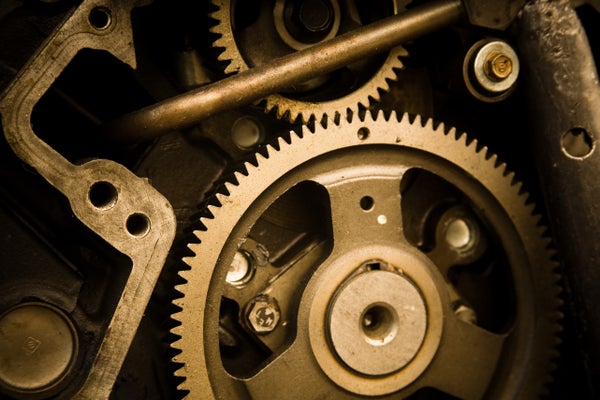
In aggregate, the internal-combustion engine almost miraculously transforms heat released by burning fuel into the smooth motion of the vehicle. The rapidly beating heart of a car is a set of engine cylinders and pistons, themselves essentially identical in form to ancient water pumps. The explosive expansion of hot gases produced by igniting fuel in the cylinders shunts out the pistons, but this back-and-forth movement must be translated into a rotation of the driveshaft and wheels. Three of the engine's components—the crank, camshaft and flywheel, all with ancient roots—deserve special mention in this process.
On supporting science journalism
If you're enjoying this article, consider supporting our award-winning journalism by subscribing. By purchasing a subscription you are helping to ensure the future of impactful stories about the discoveries and ideas shaping our world today.
The story of these parts, illustrated here in a historical chronology, demonstrates that even though the purring engine in a brand-new sports car may seem like the height of modern technological sophistication, it is in fact a mishmash of components co-opted from ancient inventions. Some of them reach back to ancient China or even the very beginnings of civilization itself.
.png?w=2000&disable=upscale)
.png?w=2000&disable=upscale)
.png?w=2000&disable=upscale)
.png?w=2000&disable=upscale)
Credit: José Miguel Mayo (engine) and Matthew Twombly (insets)