
After
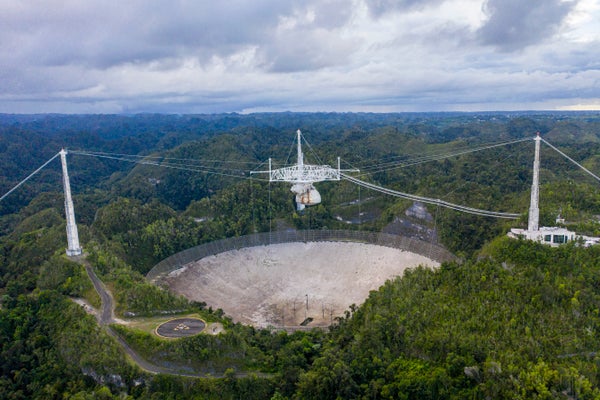
two cable failures in the span of four months, Puerto Rico's most venerable astronomy facility, the Arecibo radio telescope, has collapsed in an uncontrolled structural failure.
The U.S. National Science Foundation (NSF), which owns the site, decided in November to
On supporting science journalism
If you're enjoying this article, consider supporting our award-winning journalism by subscribing. By purchasing a subscription you are helping to ensure the future of impactful stories about the discoveries and ideas shaping our world today.
proceed with decommissioning the telescope in response to the damage, which engineers deemed too severe to stabilize without risking lives. But the NSF needed time to come up with a plan for how to safely demolish the telescope in a controlled manner.
Instead, gravity did the job this morning (Dec. 1) at about 8 a.m. local time, according to reports from the area.
"NSF is saddened by this development," the agency wrote in a tweet. "As we move forward, we will be looking for ways to assist the scientific community and maintain our strong relationship with the people of Puerto Rico."
The NSF added that no injuries had been reported, that the top priority was to maintain safety and that more details would be provided when confirmed.
"What a sad day for Astronomy and Planetary science worldwide and one of the most iconic telescopes of all time," Thomas Zurbuchen, NASA's associate administrator for science, wrote in a tweet. "My thoughts are with the staff members and scientists who have continued to do great science during the past years and whose life is directly affected by this."
Images shared on Twitter by Deborah Martorell, a meteorologist for Puerto Rican television stations, compare views of the observatory taken yesterday — showing the 900-ton science platform suspended over the massive dish strung up on cables — and today, when the
observatory's three supporting towers are bare.
None of the three towers collapsed fully, which was one of NSF's key concerns about leaving the structure as it was. Martorell's image does appear to show some damage in the knot of buildings at the base of one of the support towers, which includes administrative buildings and a public visitor's center, although the buildings are still standing.
In an
interview with local television station Noticentro, Jonathan Friedman, a physicist who works at Arecibo Observatory and lives nearby, said that he heard a loud rumble that he compared to a train or an avalanche — or to the earthquakes that plagued Puerto Rico in January. Friedman also confirmed that only the tips of the supporting towers broke off, as Martorell's image suggested.
Since the first cable failure in August, Arecibo Observatory has enforced a safety zone at the facility, although its size changed as damage was incurred and evaluated, Ralph Gaume, director of NSF's Division of Astronomical Sciences, said during a news conference held on Nov. 19, at which the NSF announced its decision to decommission the telescope.
Even during that news conference, the tenuous state of the telescope was clear. "The structure, as far as I know, is currently standing, so that implies that it is currently stable," Gaume said at the time, while also noting the 2.5-month gap between the first cable failure and the second.
The
massive radio dish has been at the forefront of atmospheric science, radio astronomy, and planetary radar capability for decades. It was also the unusual telescope to become an icon in popular culture, thanks in part to its leading roles in the movies GoldenEye and Contact.
In addition to the telescope, Arecibo Observatory also includes a LIDAR instrument that scientists use to study the area where Earth's atmosphere and space meet. When the NSF announced that it would decommission the telescope, officials emphasized that a key priority was ensuring Arecibo Observatory as a larger facility would continue.
At the time, the NSF couldn't assess whether the telescope would be replaced.
"This is a really, really hard morning for Puerto Rico, for science, for our connection to the cosmos," journalist Nadia Drake, whose father Frank Drake is a former director of Arecibo Observatory, wrote in a tweet. "RIP #Arecibo."
Copyright 2020 Space.com, a Future company. All rights reserved. This material may not be published, broadcast, rewritten or redistributed.