
1967
Nuclear Power
“By the year 2030 the electric power requirement will be 10 times the present capacity. Because of the expected decline in fossil-fuel resources, and in the absence of any other large source of energy at reasonable cost, fission power would be counted on to supply about 85 percent of this need. To fill such a demand with fission plants of the present type, however, would call for quantities of uranium ore that would soon deplete reserves. Thus, the fission age would be over almost before it began. These facts make plain how heavily the ‘fission age’ (perhaps to be followed someday by a ‘fusion age’) can depend on success in developing power plants with breeder reactors that will make the most of the available resources.”
On supporting science journalism
If you're enjoying this article, consider supporting our award-winning journalism by subscribing. By purchasing a subscription you are helping to ensure the future of impactful stories about the discoveries and ideas shaping our world today.
Matter
“Thales of Miletus, the first philosopher, is said to have asked, ‘How, and of what, is the world made?’ Perhaps in retrospect the fact that some of the laws governing atoms are different from those apparently governing bulk matter should not have been so surprising as it was. As we have seen, Democritus already realized that the components of matter were substances different from matter itself. The nuclear atom of Ernest Rutherford and Niels Bohr, as described by quantum theory, proved sufficient, as it has been said, to account for all of chemistry and most of physics.”
1917
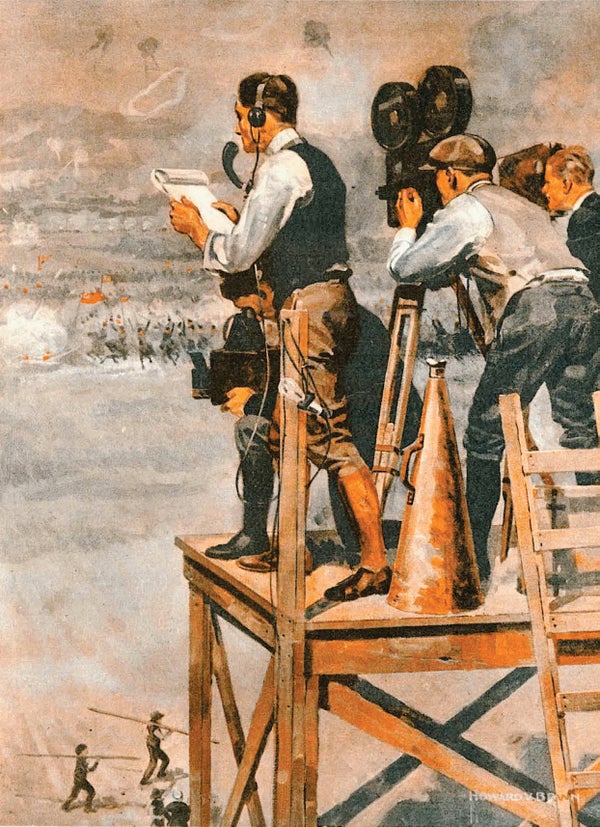
Making Movies
“With all outdoors for its stage and with nature as the scene painter, the motion picture will always possess a tremendous advantage over the legitimate drama which must necessarily confine even its most grandiose efforts to a comparatively limited stage and artificial scenery. Realizing this full well, the motion picture director works largely in the open, and when a story justifies the expense and trouble, he does not hesitate to gather an army of players and make use of a natural stage whose dimensions are measured not in feet but in miles. Big scenes are rather the exception than the rule in motion picture productions, for they are exceedingly costly.”
Archive images of the art and science of moviemaking from 1917 are at www.ScientificAmerican.com/may2017/movies-1917
Darwinism and War
“Mr. Chalmers Mitchell's new book, ‘Darwinism and War’ is a reply to the argument in favor of war, so often put forth in the last three years by a certain German school, that a state of constant struggle or warfare is a dominant factor in evolution. These writers declare that war is both necessary and admirable, and is in fact a biological law which man cannot resist, and that it is, moreover, beneficial in the long run, favoring the survival of the strongest and ablest races. Mr. Mitchell finds, however, in his own words: ‘Natural selection results from the conservation of favored races rather than from the extermination of one race by another.’ He finds nothing in common between the grouping of individuals which forms a modern nation and that which constitutes a race or species of animals. In short he believes it is entirely inadmissible to attempt to justify human conduct by laws supposed to be dominant in the animal kingdom.”
1867
Gunshot Wounds
“Dr. V. Gelcich of Los Angeles, Calif., says that there is much difficulty in discriminating between bone and the ball by the use of the ordinary probe. His probe is simply a piece of white pine wood, made in the shape of a probe, introduced into the wound, rubbed against the suspected object, and quickly withdrawn when, if it has touched the ball, traces of lead will be found upon it. He says, by this simple instrument, while a medical officer in the United States Army, he saved the limbs of two men on whom amputation was about to be performed for gunshot wounds in the lower extremities; what was long supposed to be bone proving to be lead by the aid of the white pine probe.”
Parisian Horsepower
“A French way of riding on horseback: make a pair of enormously large wheels, and place a carriage body over the axle and shafts so high that the horse can travel under it and between the wheels. You will have a most symmetrical turn-out, such as they use in Paris, of driver, horse and carriage in one, and a lofty perch where you can both see and be seen.”
