
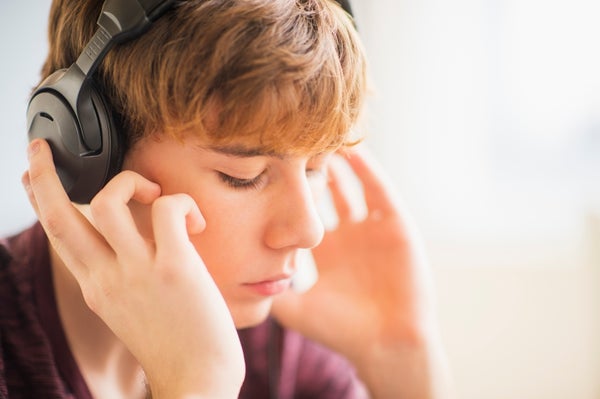
As many as two thirds of stroke victims find themselves suddenly unable to comprehend music. Beyond bad karaoke, these people fundamentally cannot differentiate pitches or rhythms. The medical term is acquired amusia, and recently scientists have aggregated data from of a large group of people with this condition to pinpoint the critical brain regions involved.
A study published in August in The Journal of Neuroscience found that the brain is incredibly modular when it comes to the perception of music and speech. Whereas lesions giving rise to deficits in language perception—a condition called aphasia—reside in the brain’s left hemisphere, damage associated with amusia are restricted to the right. Aleksi Sihvonen, a neurologist at the University of Turku in Finland and lead author of the study, says he was shocked to see such a clean split. “I think the lateralization was very surprising because the amusic pattern was so clearly in the right,” Sihvonen says. “Based on [functional neuroimaging] and left-hemisphere lesion patients who were amusic, we thought there must be [critical music perception circuitry] in the left, too.”
According to Steven Sparr, a clinical neurologist at Albert Einstein College of Medicine who was not involved in this study, trying to determine the location of music in the brain has been a long process. It goes back to 1861 when French physician Paul Broca discovered that speech resides entirely within a small circuit in the brain’s left hemisphere. So far, there has been no musical lesion case so clean as Broca’s, which has led to more than a century of frustration, Sparr says. Yet there were clues that music and language are dissociable. “A little-known fact is that Broca’s original patient who was unable to speak was able to sing La Marseillaise [the French national anthem] fluently,” Sparr says. “So from the inception of aphasia research [scientists] began to realize that singing and speaking are wired differently.”
On supporting science journalism
If you're enjoying this article, consider supporting our award-winning journalism by subscribing. By purchasing a subscription you are helping to ensure the future of impactful stories about the discoveries and ideas shaping our world today.
Why has the neurological evidence to support this notion proved so elusive? According to Sihvonen, it has to do with the case study approach. Given the idiosyncrasy of brain damage patterns as well as the fact that strokes rarely target tissue related to a single function, it can be difficult to draw strong conclusions from small samples.
What sets the present study apart is that it involved 77 participants, making it by far the most extensive of its kind. To identify the lesion locations that are most closely associated with behavioral deficits across subjects, they used a statistical method called voxel-based lesion symptom mapping (VLSM). This methodology allowed the researchers to identify the local nodes that are critically causal for music perception, in contrast to the global network that lights up when healthy people listen to music in a brain scanner. “During a functional neuroimaging scan, we don’t know if the brain activation is due to mere musical processing,” Sihvonen says. “There can be multiple cognitive processes on top, such as memory, emotions or reward. That’s why [functional] MRI is difficult to interpret.”
To be sure that the lateralization of music perception lesions was not merely an artifact of the VLSM statistics, Sihvonen and his colleagues also followed subjects during their recoveries. Both at the time of stroke and six months later, the researchers measured the extent of the lesions across three groups: those without amusia, those who recovered from amusia and those who remained amusic.
They found that those who remained amusic ultimately ended up losing more brain tissue in the auditory centers of the right hemisphere compared with recovered amusics or nonamusic stroke patients. These results are clinically important because they implicate ongoing atrophy as an important factor in persistent acquired amusia, Sihvonen says. They also reinforce the main finding that the critical areas for music perception are localized in the right hemisphere.
Although this lateralization is clear for the 77 subjects in the study, Sparr points out that only one of them had formal musical training, and prior research indicates the mental representation of music differs vastly for musicians compared with nonmusicians. “The study is very well done and very interesting, but we shouldn’t take it as the be-all, end-all, or push the data to say ‘we found the musical system of the brain,’” Sparr says. “They found the most common one, but it’s certainly not the whole story.”
Looking ahead, Sihvonen says he views large-scale lesion studies as just one piece of the puzzle. Different methods ask fundamentally different questions, and a highly complex issue like music perception requires a multifaceted approach. “It’s very intriguing to say that the amusia-associated lesions in the right hemisphere represent specific loci for music processing in the brain,” Sihvonen says. However, “it most likely involves complex global processes as well.”