
On supporting science journalism
If you're enjoying this article, consider supporting our award-winning journalism by subscribing. By purchasing a subscription you are helping to ensure the future of impactful stories about the discoveries and ideas shaping our world today.
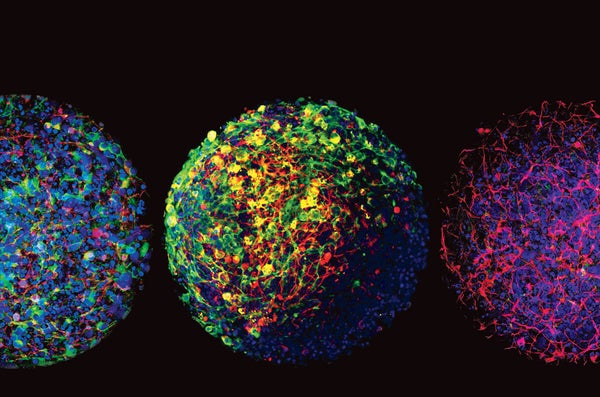
Lab-grown miniature brains are poised to shake up drug testing for everything from Alzheimer’s disease to Zika. Each bundle of human brain cells is so tiny that it could fit on the head of a pin. Researcher Thomas Hartung and his colleagues at Johns Hopkins University created these mini brains using stem cells that, over the course of two months, morph into supporting cells and various types of neurons, which quickly connect to one another and start communicating.
These three micrographs were taken with lasers to illuminate colorful fluorescent dyes. The cells’ nuclei appear purple or blue. The mini brain on the right features a tangle of axons (pink)—extensions of neurons that send and receive signals. More axons (red) and neurons that produce the neurotransmitter dopamine (green) are highlighted in the middle brain. The left one shows nerve cell bodies and their projecting dendrites (both green), as well as supporting astrocytes (red).
The mini brains are highly uniform, freezer-proof and relatively cheap. Hartung’s start-up, Organome, plans to market them soon as a substitute for lab animals in drug testing. “We are moving into cell culture for the 21st century,” he says.