
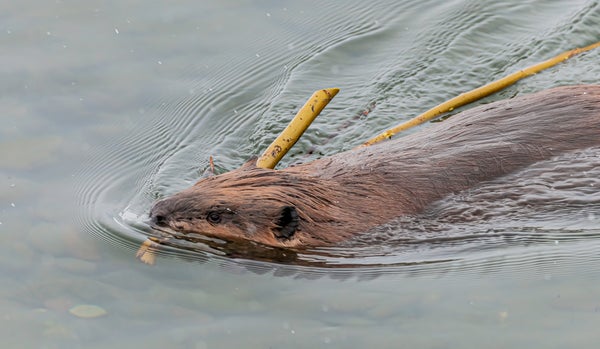
CLIMATEWIRE | Behold the beaver: master engineer, wetland dweller and a national symbol of Canada.
Now add climate change specialist to the list, scientists say.
According to new research, beavers are among the world’s most effective practitioners of climate adaptation and resilience, something biologists have known for years but have recently documented through field study.
On supporting science journalism
If you're enjoying this article, consider supporting our award-winning journalism by subscribing. By purchasing a subscription you are helping to ensure the future of impactful stories about the discoveries and ideas shaping our world today.
Experts from the Northwest Fisheries Science Center and the California State University Channel Islands say that as droughts and floods become more acute with global warming, dam-building beavers are helping stave off the worst impacts by holding back essential water that otherwise would run off or dry up.
“It may seem trite to say that beavers are a key part of a national climate action plan, but the reality is that they are a force of 15–40 million highly skilled environmental engineers. We cannot afford to work against them any longer; we need to work with them,” Chris E. Jordan and Emily Fairfax wrote in their paper titled “Beaver: The North American freshwater climate action plan.”
The research, published in the journal WIREs Water, found that the kind of climate benefits provided by a species like the beaver — categorized as “low-tech process-based stream restoration” — are “rapidly gaining traction in the face of looming climate and biodiversity crises.”
“If you just put a beaver there and let it do its thing, the number of ecosystem services they provide to help with climate change, it’s huge,” Fairfax said in a phone interview last week.
“It’s also less expensive: Beavers are free.”
They are also abundant, which poses a unique challenge for the landscape-altering mammal both in North America and elsewhere.
For centuries, Eurocentric cultures valued beaver only for their pelts, and they were hunted to fractions of their natural populations across their traditional range, according to researchers.
As human settlement encroached upon streams and wetlands, beaver populations crashed again by as much as 90 percent, even as they continued to thrive in wild areas and pockets of protected habitat. Their dam-building ways also earned them a reputation as pests, especially to farmers.
Fairfax noted that while restoring public acceptance is a gradual process, wildlife managers have come to value the animals for their role in creating fire protection.
She characterized such natural adaptation measures as “low-hanging fruit” — meaning it requires virtually no effort on the part of those seeking fire protection. “Wildfires in California are getting out of control year after year, so people are saying, ‘You know, I’ll take the flooding if it means I won’t burn,” Fairfax said.
“I’m happy to see people going out of the traditional disaster mode and taking a chance on beavers,” she added.
In Oregon, the nonprofit organization Beaver Works has promoted beaver swamps as a critical habitat for other species such as deer, elk, fish and songbirds that also provides cool riparian environments during hot days. “Without these ponds and channels — without the beaver — wildlife habitat on high desert landscapes becomes increasingly scarce which accelerates with climate change,” the group states on its website.
California recently approved a specialized license plate program sought by Democratic Gov. Gavin Newsom that should yield more than $1.6 million during the next fiscal year and $1.4 million annually thereafter for climate resilience through beaver habitat restoration. When introducing the proposal in May, Newsom characterized the beaver “an untapped, creative, climate-solving hero.”
Reprinted from E&E News with permission from POLITICO, LLC. Copyright 2022. E&E News provides essential news for energy and environment professionals.