
My preschooler is obsessed with rules—and, more important, exploring their loopholes. When I tell him to stop throwing rocks, he will drop a rock dramatically with a loud thud, assuming plausible deniability. Pretending to be a Tyrannosaurus rex, he will chase his little sister around our kitchen island and push her. “Don’t push your sister,” I’ll command, and he will reply, “I didn’t push her! The dinosaur did it.”
Self-control is one’s ability to navigate multiple competing desires—such as listening to your mother and shoving your sister. We tend to idolize people who show certain kinds of self-control (such as professional athletes) and demonize those who we think don’t show enough (for example, athletes who get caught in doping scandals).
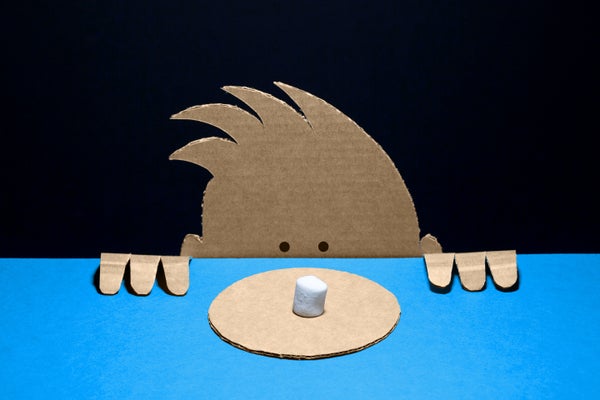
When I think about self-control in children, I think about psychologist Walter Mischel’s marshmallow test, in which children could either eat a single marshmallow immediately or show self-control, refuse that first marshmallow and be rewarded with two marshmallows later. The original studies found that children who waited for the additional marshmallows had more academic success in adolescence compared with those who gave in to temptation.
On supporting science journalism
If you're enjoying this article, consider supporting our award-winning journalism by subscribing. By purchasing a subscription you are helping to ensure the future of impactful stories about the discoveries and ideas shaping our world today.
But what if the marshmallow way of thinking about self-control is wrong? Maybe it’s about not just avoiding the tempting first marshmallow but the myriad other things that go along with that: planning for the future, following rules, working hard and trusting that you’ll indeed get your eventual reward. In other words: being conscientious.
Teaching conscientiousness—a personality trait that’s about more than self-control—may actually be the path to helping our children be the best versions of themselves.
In a recent review, researchers found that achieving in-the-moment self-control (for instance, waiting for a second marshmallow one time) does not lead to monthslong or yearslong changes in how consistently we apply such control. Unfortunately, changing our personalities to resist temptation is not so easy. In fact, even people who seem to show more consistent self-control don’t necessarily do so all the time. On the contrary, they tend to simply avoid temptation in the first place so they don’t have to exercise restraint, and they show less (not more) self-control in their daily lives.
Compared with extroversion, conscientiousness is more strongly related to academic success, work performance and lower rates of substance use. Conscientious people have grit.
It turns out that the results from the classic marshmallow test are more complicated than first thought. Performance on the test and future academic success are related not just to self-control but to factors such as a child’s general cognitive ability and how much education their parents have. Further, it does not seem that one’s ability to wait for that second marshmallow is related to success into adulthood.
Conscientiousness is one of the Big Five personality traits that predict academic success (alongside extroversion, agreeableness, neuroticism and openness to experience). Conscientious people often show self-control, but they also follow rules, show up on time and work hard.
Conscientiousness is often underappreciated. In one study, new mothers said they hoped their babies would grow up to be extroverted and agreeable, but they consistently ranked conscientiousness as less preferable than almost all other traits. If extroversion is the life of the party and agreeableness is that one friend who laughs at all our jokes, we may have a tendency to view conscientiousness as a wet blanket, the person who asks to turn the music down or has to leave early to get to bed on time.
Conscientiousness, however, is associated with the same (and arguably more) benefits as self-control: Conscientious people have better health, are less likely to be depressed, are wealthier and live longer than people who are less conscientious. Compared with extroversion, conscientiousness is more strongly related to academic success, work performance and lower rates of substance use. Conscientious people have grit.
Rather than the dud at the party, think instead of your friend who always remembers your birthday, a co-worker who volunteers for the hardest assignment or a judge who upholds the law even when it is unpopular. We could use more conscientiousness in our world.
Conscientiousness appears to be about 40 to 50 percent heritable, so conscientious parents tend to raise conscientious kids. This fact also suggests that environment and upbringing play substantial roles in determining whether people become conscientious adults.
Authoritative parenting, characterized by warmth, structure and limit-setting, appears to be related to higher rates of conscientiousness in children. Authoritative parenting is also related to secure attachment between parents and children, which is associated with more conscientiousness.
One way we could engage in authoritative parenting and translate some of these ideas into practice might be to explicitly explain to our children why we make the rules we make. Early indicators of conscientiousness may be how readily children follow a parent’s instructions and how positively they embrace family rules. That suggests that parents who expect children to do these things may be helping their kids become more conscientious over time. Rather than telling my son he shouldn’t shove people “because I said so,” I could explain that our family believes it’s important not to hurt others and that we don’t push others because we could hurt them (even when we’re dinosaurs).
We can also look at what conscientious people do in their daily lives outside of self-control behaviors and try to model those other actions for our kids. If we want to model punctuality and responsibility, we could explain why it’s important for our family to show up for a playdate on time and then (heroically!) do it. We could also describe to our kids all the things we need to do—pack snacks, put gas in the car, feed the dog—before we can get to our friend’s house as a way to demonstrate good planning.
Thinking about the research on how adults who show more consistent self-control over time often exhibit less, not more, self-control moment to moment, we might try to provide our children with opportunities to safely test boundaries and allow their impulses some freedom. Sometimes my family has what we call “yes days” where we try to say yes to whatever our kids desire (within reason) for an afternoon. Milkshakes for dinner? Sure. Want to chase some birds at a park for hours? Go wild.
Cultivating conscientiousness in our children may not only help them thrive but help us manage our own stress. One study of children in France found that traits such as agreeableness and conscientiousness in the kids were related to less burnout in their parents, including parents who reported less emotional exhaustion and more self-efficacy in their parenting.
There’s still a lot we don’t know about how conscientiousness develops. Personality traits are hard to change, as are cognitive skills, depending on your child’s abilities. For example, if your child has attention deficit hyperactivity disorder or is otherwise neurodiverse, a change in parenting practices alone probably will not be enough to help that child become a better planner or more rule-abiding. It might take longer. Conscientiousness for them might look different than in other kids. All children, regardless of ability, deserve parents with realistic and flexible expectations around the potential for change as we work toward nurturing conscientiousness in our families.
It’s tiring to explain to my son for the hundredth time why we don’t shove people. The other day, however, my daughter decided to shove her brother, and I heard him explain to her in a tone not unlike my own, “We don’t push people in our family!” As he came running to tattle on his sister, all I could do was laugh.