
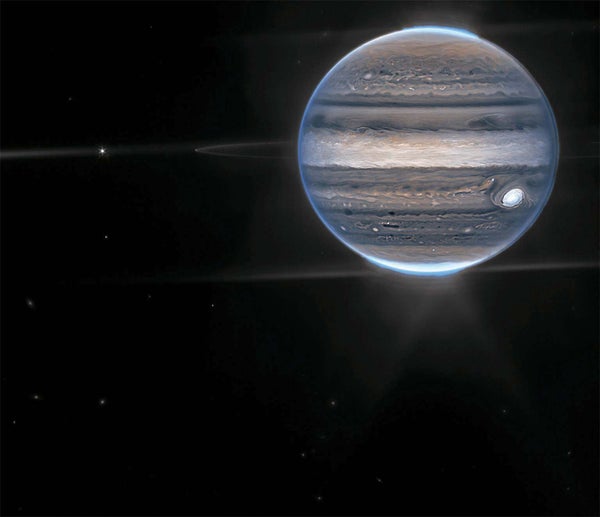
Jupiter's rings, its moons Amalthea (bright point at left) and Adrastea (faint dot at left tip of rings), and even background galaxies are visible in this image from JWST's NIRCam instrument. Whiter areas on the planet represent regions with more cloud cover, which reflects sunlight, especially Jupiter's famous Great Red Spot; darker spots have fewer clouds. Perhaps the most stunning feature is the blue glow of the planet's auroras at the north and south poles. These light shows result when high-energy particles streaming off the sun hit atoms in Jupiter's atmosphere. Auroras are found on any planet with an atmosphere and a magnetic field, which steers the sun's particles to the poles; besides Earth and Jupiter, telescopes have seen auroras on Saturn, Uranus and Neptune.
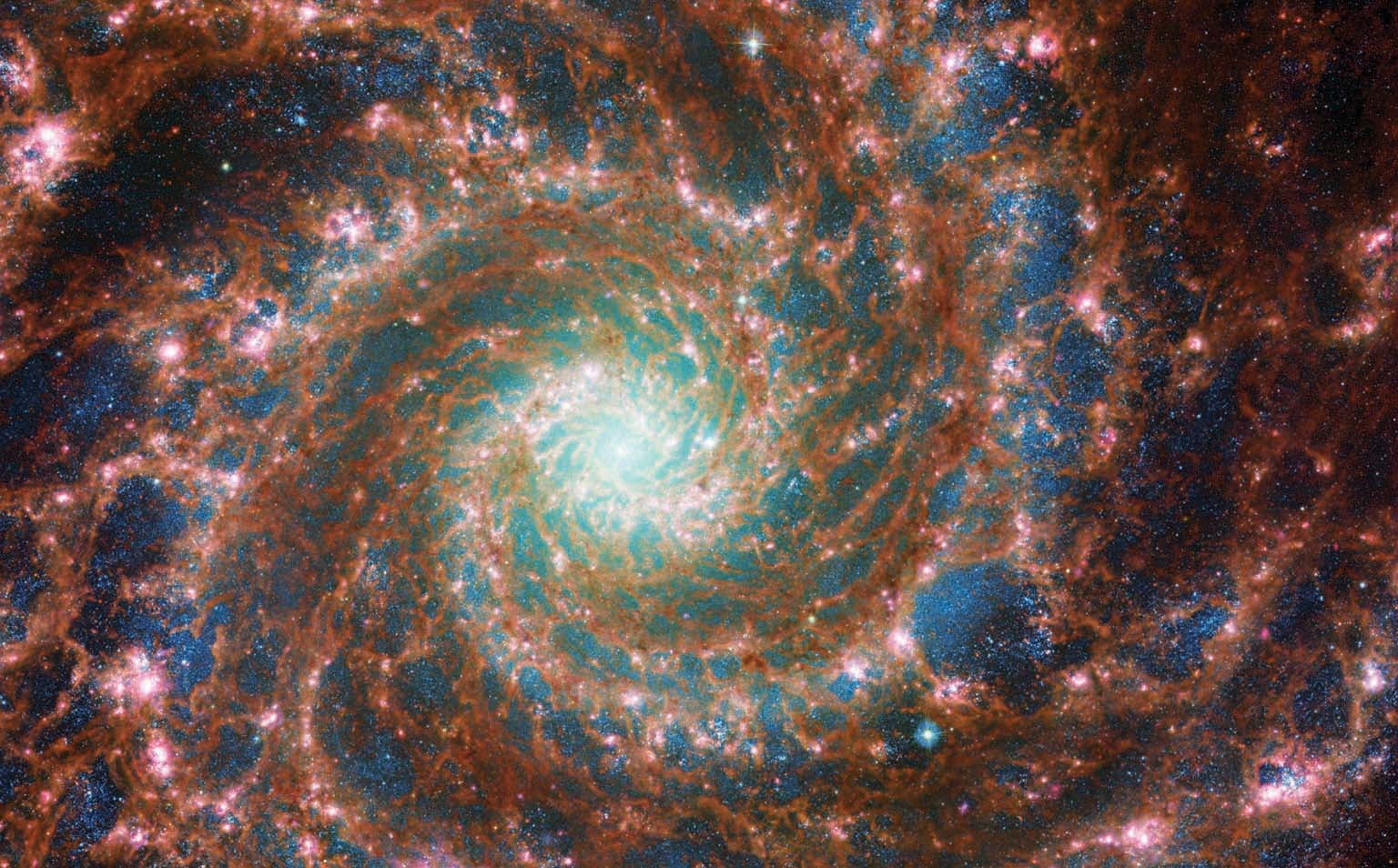
Credit: ESA/Webb, NASA and CSA, J. Lee and PHANGS-JWST Team; ESA/Hubble and NASA, R. Chandar; Judy Schmidt
The phantom galaxy, M74, forms mesmerizing swirls in this photo combining observations from JWST and Hubble. Visible-light data from Hubble showcase the starlight in this spiral, including older, redder stars at the galaxy's glowing core and younger, bluer stars on its outskirts. The infrared light captured by JWST, however, highlights the gas and dust threaded through the spiral arms, as well as a bright cluster of stars at the heart of the galaxy. Each telescope sees a different aspect of this cosmic wonder, and the combined image offers a fuller picture than ever before.
On supporting science journalism
If you're enjoying this article, consider supporting our award-winning journalism by subscribing. By purchasing a subscription you are helping to ensure the future of impactful stories about the discoveries and ideas shaping our world today.
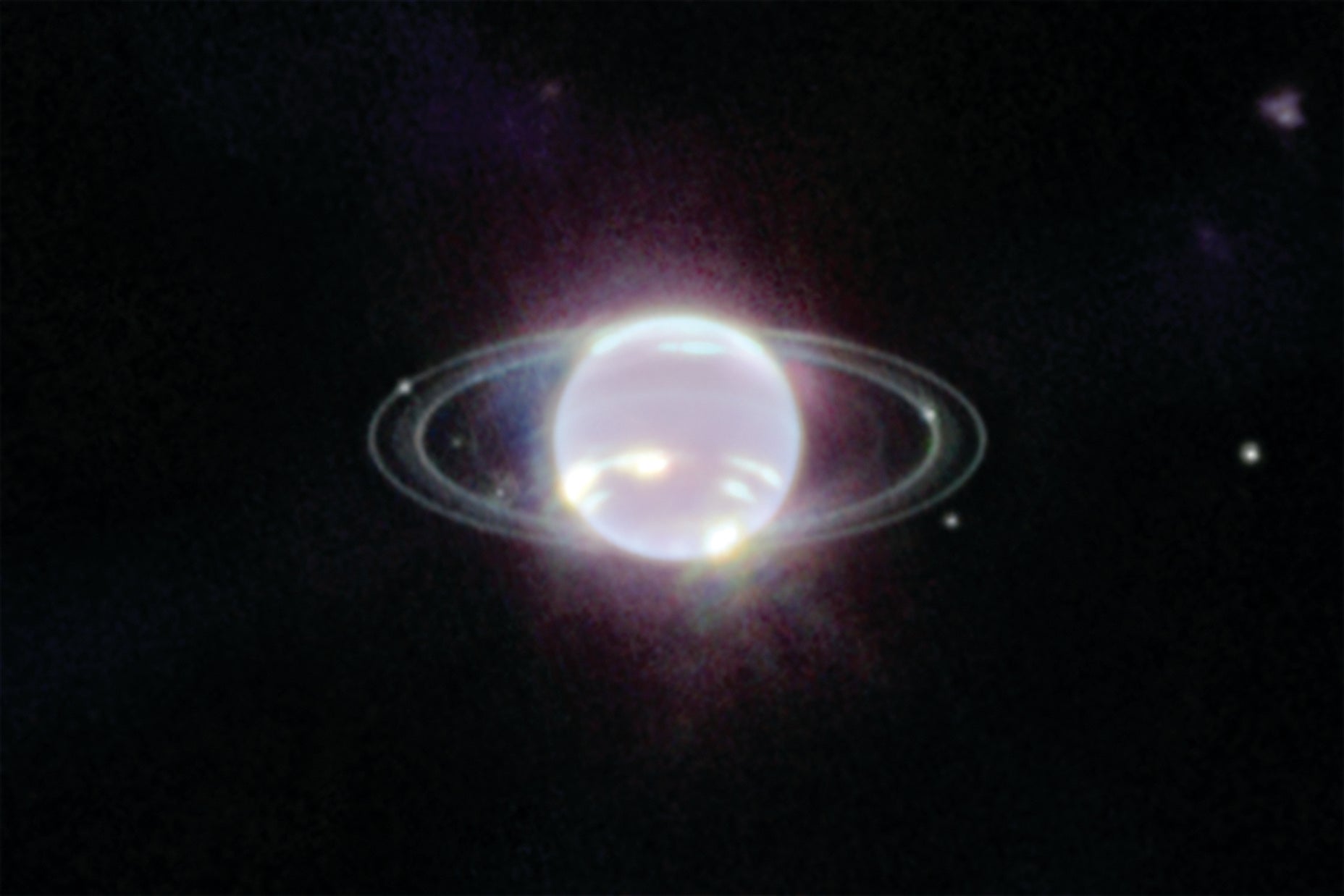
Credit: Joseph DePasquale/STScI, Anton M. Koekemoer/STScI, NASA, ESA, CSA and STScI
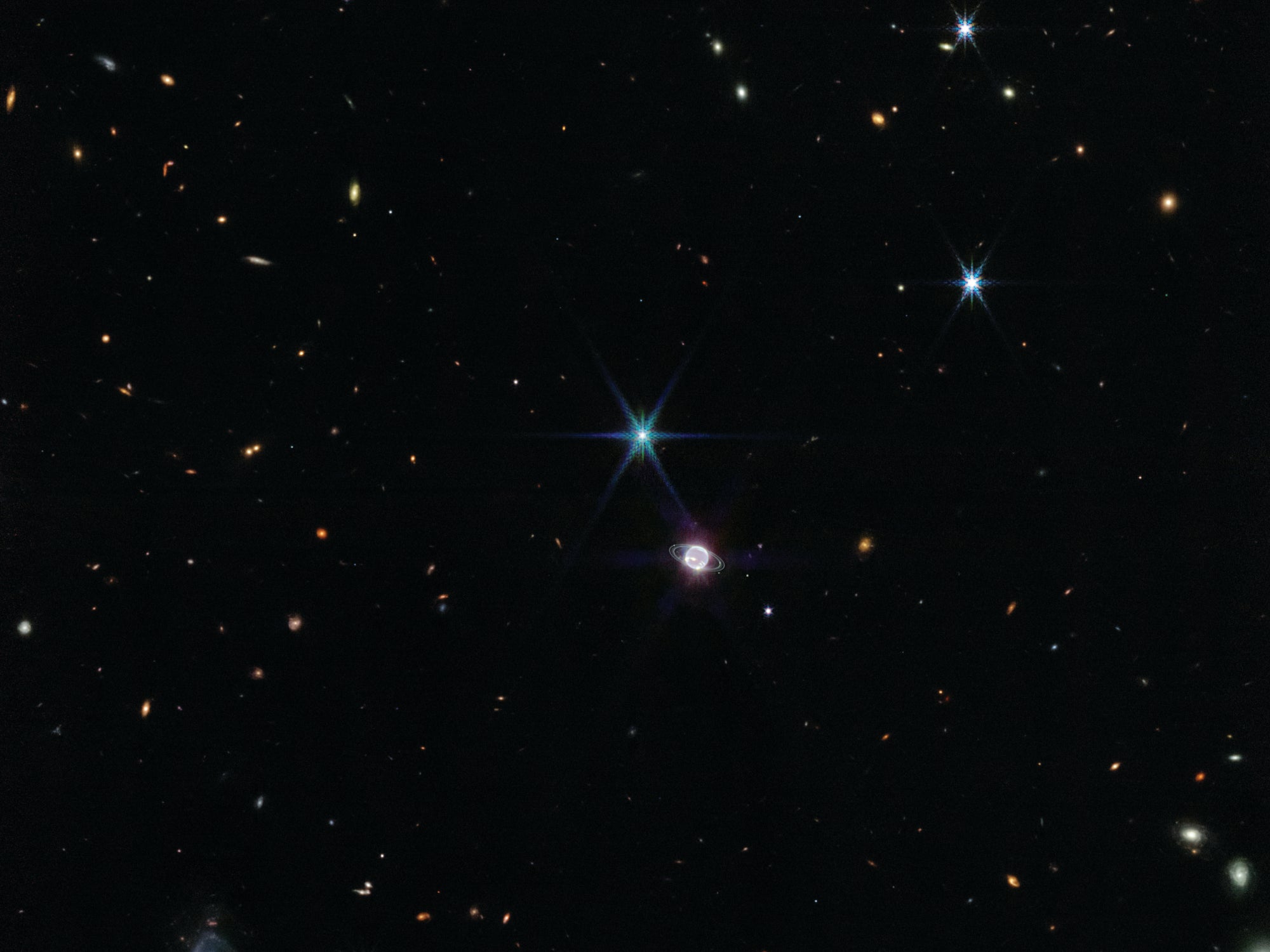
Credit: Joseph DePasquale/STScI, Anton M. Koekemoer/STScI, NASA, ESA, CSA and STScI
JWST enabled this first-ever view of Neptune's rings in infrared, revealing their delicate gossamer glow. The photo also shows seven of the planet's moons, including its largest satellite, Triton, the bright blue dot to Neptune's upper left. The moon's frozen nitrogen surface reflects 70 percent of the sunlight it receives, causing it to shine powerfully in the infrared. Distant galaxies sprinkle the background of this wide-field shot. In the inset, Neptune's layers of rings are clearly visible: two thin, bright ovals and two fainter, spread-out layers. Gleaming spots caused by methane ice clouds in the planet's atmosphere dapple its lower half.