
The asteroid Vesta does not qualify as a planet, not even a dwarf planet. But the giant asteroid has plenty to offer planetary scientists nonetheless.
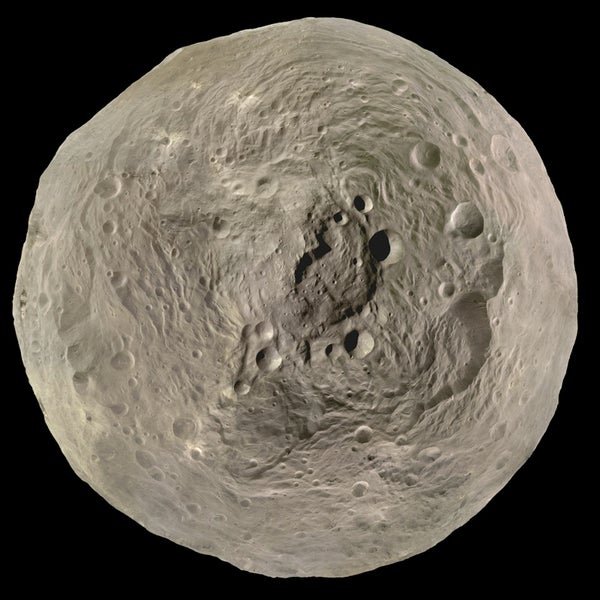
Vesta appears to be a differentiated body, like Earth, with distinct layers of core, mantle and crust. It also features some pretty dramatic topography. This photomosaic of Vesta's south pole, from NASA's Dawn spacecraft, centers on one of the tallest mountains in the solar system. The central peak within the crater Rheasilvia rises 22 kilometers, comparable with Mars's Olympus Mons and much higher than any mountain on Earth.
The mosaic comprises roughly three dozen images acquired by the Dawn spacecraft’s framing camera in 2011 and recently made available to the public. Daniel Macháček assembled the mosaic, along with several others, for his blog My Favorite Universe. In an English-language translation blog post for the Planetary Society, Macháček explained one curious feature of the mosaic—the unnatural pattern of shadows, which owes to Vesta's rapid rotation. "The shadows change so fast that there is not a set of images covering all of Vesta with the same lighting and from the same relative position of Vesta and Dawn," Macháček wrote. "My most viable option was to use the frames with the best lighting and minimal number of shadows."
On supporting science journalism
If you're enjoying this article, consider supporting our award-winning journalism by subscribing. By purchasing a subscription you are helping to ensure the future of impactful stories about the discoveries and ideas shaping our world today.
Dawn shoved off from orbit around Vesta in September and headed for an even bigger asteroid. The spacecraft should arrive at Ceres, a body so large that it has been officially recognized as a dwarf planet, in 2015.
—John Matson