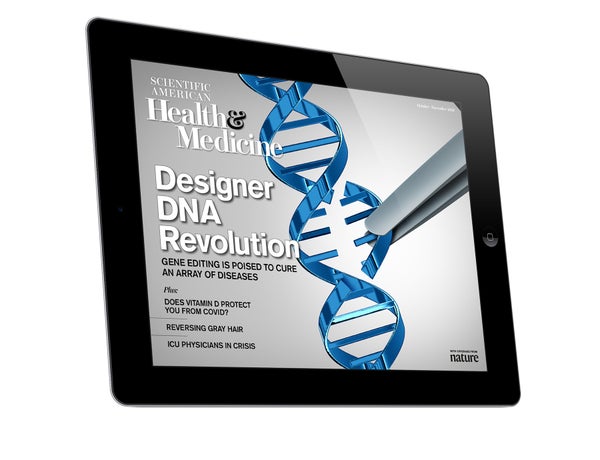
The Blueprints of Health

Credit: Scientific American Health & Medicine, Vol. 3, Issue No. 5

Join Our Community of Science Lovers!


On supporting science journalism

If you're enjoying this article, consider supporting our award-winning journalism by subscribing. By purchasing a subscription you are helping to ensure the future of impactful stories about the discoveries and ideas shaping our world today.


Medicine accomplished a huge feat at the start of 2020, when researchers produced the first mRNA vaccine to protect humans from SARS-CoV-2 infection. It was certainly not new technology—the vaccine platform had been under development for more than a decade and tested against multiple diseases, from flu to rabies. It represents our rapidly advancing understanding of how the body manufactures proteins, the molecules that are coded for by our genes. The potential to manipulate the very blueprints that our cells use to build the molecules and cells at the heart of disease is undoubtedly a game changer. Beyond vaccines, researchers have been devising treatments for cancer, lymphoma, AIDS, cystic fibrosis, and more, aided by new gene-editing technology, as physician Carolyn Barber (see “How Designer DNA Is Changing Medicine”) profiles in this collection. The next generation of lifesaving treatments may be manufactured right in our own bodies.

Such genetic advancements are being hyped as a way for prospective parents to screen their embryos for future diseases—but the technology might not be ready for primetime, as genetic counselor Laura Hercher writes (see “A New Era of Designer Babies May Be Based on Overhyped Science”). And as always we have updates on the latest COVID news—from breakthrough infections (see “ ‘Breakthrough’ Infections Do Not Mean COVID Vaccines Are Failing) to a surprising COVID risk (see “People with COVID Often Infect Their Pets”). Here’s to your health, now and in the future!

Andrea Gawrylewski is chief newsletter editor at Scientific American. She writes the daily Today in Science newsletter and oversees all other newsletters at the magazine. In addition, she manages all special editions and in the past was the editor for Scientific American Mind, Scientific American Space & Physics and Scientific American Health & Medicine. Gawrylewski got her start in journalism at the Scientist magazine, where she was a features writer and editor for "hot" research papers in the life sciences. She spent more than six years in educational publishing, editing books for higher education in biology, environmental science and nutrition. She holds a master's degree in earth science and a master's degree in journalism, both from Columbia University, home of the Pulitzer Prize.

More by Andrea Gawrylewski
SA Health & Medicine Vol 3 Issue 5This article was published with the title “The Blueprints of Health” in SA Health & Medicine Vol. 3 No. 5 ()
doi:10.1038/scientificamerican102021-58Lhmy5fpLjF63lMzCoUzJ

It’s Time to Stand Up for Science

If you enjoyed this article, I’d like to ask for your support. Scientific American has served as an advocate for science and industry for 180 years, and right now may be the most critical moment in that two-century history.

I’ve been a Scientific American subscriber since I was 12 years old, and it helped shape the way I look at the world. SciAm always educates and delights me, and inspires a sense of awe for our vast, beautiful universe. I hope it does that for you, too.

If you subscribe to Scientific American, you help ensure that our coverage is centered on meaningful research and discovery; that we have the resources to report on the decisions that threaten labs across the U.S.; and that we support both budding and working scientists at a time when the value of science itself too often goes unrecognized.

In return, you get essential news, captivating podcasts, brilliant infographics, can't-miss newsletters, must-watch videos, challenging games, and the science world's best writing and reporting. You can even gift someone a subscription.

There has never been a more important time for us to stand up and show why science matters. I hope you’ll support us in that mission.

Thank you,

David M. Ewalt, Editor in Chief, Scientific American

Subscribe