
Editor’s Note (4/23/20): Our partners at Live Science have edited this story after posting. It originally said the forensic practitioner it describes had died of the coronavirus. BuzzFeed News has now reported that that individual is not dead. And the Journal of Forensic and Legal Medicine, where the case was published, has issued a correction. In the original report, researchers wrote that “this is the first report on COVID-19 infection and death among medical personnel in a Forensic Medicine unit.” In the journal’s correction, the authors say they “did not mean to suggest that the victim had died, and that [they] do not know for sure and cannot scientifically confirm that the virus moved from the dead body.”
Even after death,
COVID-19 could be contagious, a new report finds.
On supporting science journalism
If you're enjoying this article, consider supporting our award-winning journalism by subscribing. By purchasing a subscription you are helping to ensure the future of impactful stories about the discoveries and ideas shaping our world today.
A forensic practitioner working in Bangkok, Thailand, most likely caught the virus from a deceased patient, according to the report, which was posted online April 11 as a preprint for the
Journal of Forensic and Legal Medicine.
At the time the report was written on March 19, just 272 people in Thailand — including the forensic practitioner and a nurse assistant — had tested positive for the new coronavirus. Most of these cases were imported, meaning they weren't from community spread, the researchers wrote. So, it's unlikely that the forensic practitioner caught the new
coronavirus outside of work or even from a patient at the hospital, the researchers wrote.
"There is [a] low chance of forensic medicine professionals coming into contact with infected patients, but they can have contact with biological samples and corpses," the researchers wrote in the report.
It's not surprising that the body of a recently deceased COVID-19 patient might be contagious, said Dr. Otto Yang, a professor in the Department of Medicine and the Department of Microbiology, Immunology and Molecular Genetics at the David Geffen School of Medicine at UCLA.
"Absolutely, a dead body would be contagious at least for hours if not days," Yang told Live Science in an email. "The virus will still be in
respiratory secretions, and potentially still reproducing in cells that haven't yet died in the lungs."
COVID-19's possible longevity in the body may be problematic for people in the funerary industry. For instance, following reports that temples in Thailand were refusing to perform funeral services of COVID-19 victims, the head of Thailand's Department of Medical Services announced on March 25 that the disease was not contagious in bodies after death,
according to BuzzFeed News.
It's unclear, however, just how long the virus remains infectious in a dead body.
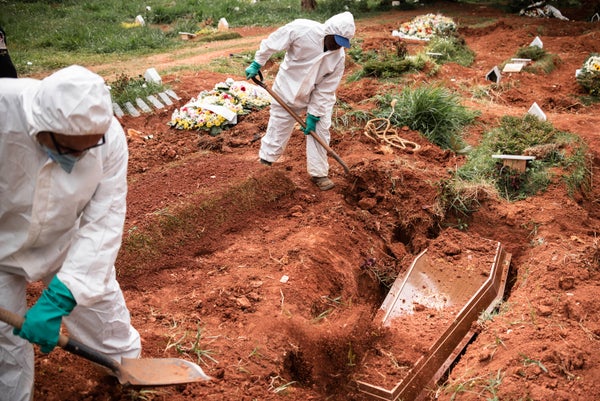
In light of this finding, forensic scientists should take a number of precautions while examining the remains of COVID-19 patients, the researchers said. For instance, forensic professionals should wear protective gear, including a protective suit, gloves, goggles, a cap and a mask, they wrote.
"The disinfection procedure used in operation rooms might be applied in pathology/forensic units too," they added.
Usually, pathogens that kill people don't survive long enough to spread to others after the person's death,
according to the World Health Organization (WHO). "Human remains only pose a substantial risk to health in a few special cases, such as deaths from cholera or haemorrhagic fevers," such as Ebola, the WHO said.
Other illnesses that are contagious in human remains include
tuberculosis, bloodborne viruses (such as hepatitis B and C and HIV) and gastrointestinal infections (including E. coli, hepatitis A, Salmonella infection and typhoid fever), according to the WHO.
Copyright 2020 LiveScience.com, a Future company. All rights reserved. This material may not be published, broadcast, rewritten or redistributed.
Read more about the coronavirus outbreak here.