
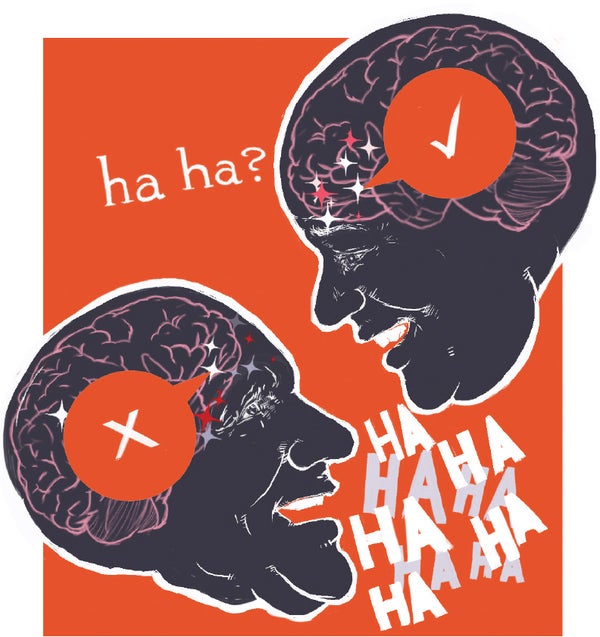
Most of us will laugh at a good joke, but we also laugh when we are not actually amused. Fake chuckles are common in social situations—such as during an important interview or a promising first date. “Laughter is really interesting because we observe it across all human cultures and in other species,” says Carolyn McGettigan, a cognitive neuroscientist at Royal Holloway, University of London. “It's an incredibly important social signal.”
In a 2013 study, McGettigan, then a postdoctoral researcher at University College London, and her colleagues scanned the brains of 21 participants while they passively listened to clips of laughter elicited by funny YouTube videos or produced on command (with instructions to sound as natural as possible). Subjects whose medial prefrontal cortex “lit up” more when hearing the posed laughter were better at detecting whether laughs were genuine or not in a subsequent test. (This brain region is involved in understanding the viewpoint of others.) “If you hear a laugh that seems ambiguous in terms of what the person means,” McGettigan explains, “it makes sense that you're going to try to work out why this person sounds like this.”
In a follow-up study in 2016, McGettigan and her colleagues recruited a fresh set of participants to rate the laugh tracks on various qualities, such as authenticity and positivity. They compared these findings with the original brain data and found that the activity in the medial prefrontal cortex was negatively correlated with the genuineness of the laughs. Their analyses also revealed that both types of laughter engaged the auditory cortices, although activity in these brain regions increased as the laughs became happier, more energetic and more authentic.
On supporting science journalism
If you're enjoying this article, consider supporting our award-winning journalism by subscribing. By purchasing a subscription you are helping to ensure the future of impactful stories about the discoveries and ideas shaping our world today.
Greg Bryant, a cognitive scientist at the University of California, Los Angeles, who was not involved in the study, says the findings are consistent with his research. “It doesn't look like the brain is really working that hard to classify laughs as much as it's working to figure out the vocalizer's intention,” he observes.
“Evolutionarily speaking, it's good to be able to detect if someone is authentically experiencing an emotion versus if they're not,” McGettigan says, “because you don't want to be fooled.”