
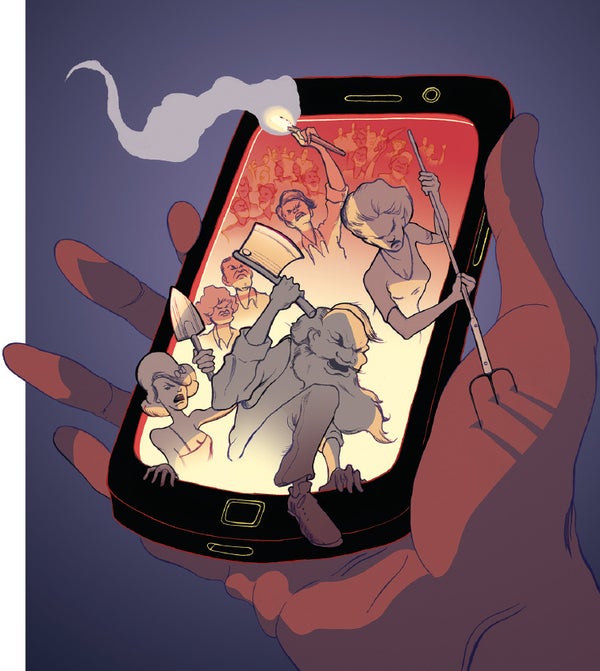
Brian Williams. Anthony Weiner. Social media mogul Sean Parker. Plagiarist Jonah Lehrer. Walter Palmer, the dentist who shot Cecil the lion. The woman who sued her nephew in Connecticut for knocking her down with a hug at his eighth birthday party. The tourist who gave the finger to a “Silence and Respect” sign at Arlington National Cemetery. The woman who tweeted, “Going to Africa. Hope I don't get AIDS.”
By now everyone knows about Internet shaming. Someone makes a mistake in judgment—or seems to because the story is repeated without context—and it goes viral. The public responds on Twitter and Facebook with a bombardment of vitriol, threats and humiliation and, often, an attempt to destroy the person's job, home and family.
“Lowlife c***. I'd love to smash your teeth in,” goes the typical tweet. “I'd put a cross bow bolt through Walter Palmer then track him [for] 40 hrs, shoot him, behead him, skin him and sleep peacefully.” When the victim of shaming is female, the tweets are often sexually violent: “Somebody (HIV+) must rape this b**** and we'll see if her skin color protects her from AIDS.”
On supporting science journalism
If you're enjoying this article, consider supporting our award-winning journalism by subscribing. By purchasing a subscription you are helping to ensure the future of impactful stories about the discoveries and ideas shaping our world today.
Because of their immensity and anonymity, these floggings feel infinitely worse than, say, being booed off a live stage. It feels as though the entire world has judged you, found you worthless. Then it gets worse. The mob starts working to destroy your life.
In 2012 Adam Mark Smith accosted a Chick-fil-A clerk for working for a company that supports hate groups. When the video hit YouTube, the mob filled his employer's voice mail with bomb threats; he lost his job within 24 hours.
“I'd get voice mails and … texts [saying] ‘You deserve to die. I hope you lose your kids. You … are … a horrible human being,’” Smith told me in an interview for CBS News. They nailed a swastika to his front door. They mailed him a package full of human feces. They posted the address of his young children's elementary school, with directives to harass them. Smith had to move.
One potential employer after another withdrew their job offers. He wound up on food stamps. He contemplated suicide.
In his 2015 book So You've Been Publicly Shamed, Jon Ronson makes it clear that public shaming isn't new. We used to put wrongdoers in the stocks in the public square or, centuries before that, stone them. The anonymity and speed of the Internet, of course, just make shamings easier to start, execute and coordinate.
Any reasonable person would agree that, for a politically insensitive act or tasteless joke, permanently ruining someone's life is too harsh a penalty. But these days public shamings are increasingly frequent. They've become a new kind of grisly entertainment, like a national reality show.
The truth is, the cybermob phenomenon won't go away. Human nature is what it is. Psychology is at play. When they can't see their victims, people tend to be far more vicious than they would be face-to-face (the online disinhibition effect). And even if some people might be inclined to defend the victim or add some context, they don't, because they don't want to get in the cross fire (the bystander effect).
Yet in a twisted way, there's a certain kind of hope in the increasing regularity of shamings. As they become commonplace, maybe they'll lose their ability to shock. The same kinds of ugly tweets have been repeated so many times, they're starting to become boilerplate.
If you're a target, it's not actually about you. You're a symbol, a faceless bull's-eye for the frustrations of your attackers. Furthermore, you're only the hate symbol du jour; the Internet's sights will be on someone else next week. And as time goes by, the novelty wears off, and the pattern becomes predictable, then maybe it will be easier for victims to accept that at least an Internet shaming isn't personal. In the end, it's just a sport.