
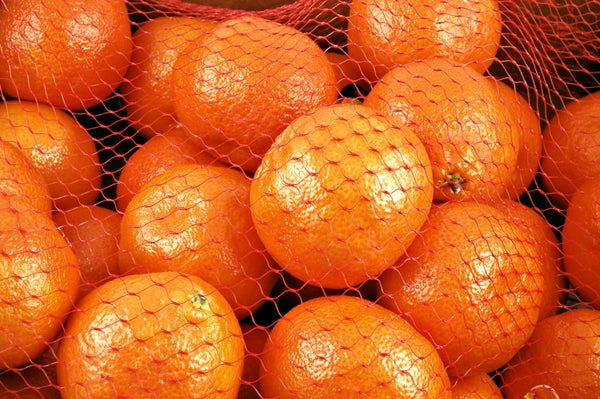
In the supermarket you inspect oranges in a net bag. They look ripe and appetizing. Then, when you get home, you are shocked: they’re still green! This is caused by a perceptual phenomenon known as color assimilation or the confetti illusion: objects appear to take on the color of a pattern placed over them. The product sells better when it’s in a net that’s the color of specimens of perfect ripeness. What is already well known in the fruit-and-vegetable trade now has a scientific basis. (Of course, Citrus Red No. 2 dye can also make green oranges appear ripe. But undyed fruit, such as organic produce, can still be spiffed up with the confetti illusion.)
Karl Gegenfurtner, a perception psychologist at Justus Liebig University Giessen [AS1] in Germany, has has shown how this illusion works in fruit in in a short paper in the journal i-Perception. A perceptual illusion is generally understood to be an incorrect interpretation of sensory stimuli. The phenomenon is based on the fact that stimuli always represent incomplete information, which is only combined with your experiences to put together a sensory impression. This can lead to errors.
Gegenfurtner himself had previously found that oranges he had bought were not actually as ripe as they appeared to be through the net. After the initial disappointment, the color researcher’s interest was aroused. To rule out the possibility that the observed effect was caused only by reflections between the net and the fruit, he graphically re-created the net as a striped pattern and placed a photograph of a greenish, shimmering, unripe orange behind it. Lo and behold the piece of fruit suddenly appeared noticeably darker.
On supporting science journalism
If you're enjoying this article, consider supporting our award-winning journalism by subscribing. By purchasing a subscription you are helping to ensure the future of impactful stories about the discoveries and ideas shaping our world today.
“These findings highlight the significant implications of color assimilation in everyday consumer environments, offering a fresh perspective on how visual perception can be manipulated,” Gegenfurtner wrote in his study. “Looking around in typical supermarkets, it is easy to see that fruits and vegetables (e.g., lemons, onions, zucchini, or even potatoes) are typically packaged in nets that are of the color of perfect exemplars.” Light reflections between the net and the fruit may even increase the color saturation.
To show how powerful the optical phenomenon can be in his paper, Gegenfurtner also demonstrated the confetti illusion with the faces of the three founders of trichromatic color theory: Hermann von Helmholtz, James Clerk Maxwell and Thomas Young. The effect is astonishing: The faces change hue depending on the colors of the striped pattern. And in a black-and-white version of the demonstration, the faces become very dark or very light. The illusion provides “a big chuckle for the color scientist, a sad moment for the consumer!” Gegenfurtner concluded.
This article originally appeared in Spektrum der Wissenschaft and was reproduced with permission.