
A baseball thrown by a top-flight power pitcher makes noise. “Oh, you can definitely hear a fastball,” former Yankee Derek Jeter says in the excellent new documentary Fastball. “You can hear it whizzing by you. It sounds like trouble is what it sounds like. If you're facing someone with some control problems, it can be a very, very troubling experience.”
I saw a preview of Fastball in March at the Yogi Berra Museum & Learning Center on the campus of Montclair State University in New Jersey. And the movie wasn't over even when it was over, because I bought a copy for repeated viewings. Baseball fans will obviously be fascinated by Fastball. But science aficionados will find a lot to like, too. If you love science and baseball, watching it will cause flights of angels to sing to thee. Possibly including Nolan Ryan, California Angel, 1972–1979.
The film examines everything from the physics governing the trajectory of the ball to the physiology of the strain on the pitcher's arm to the psychology of hurling a potentially deadly projectile awfully close to the head of another human being to the neuroscience of the batter's perception and reaction.
On supporting science journalism
If you're enjoying this article, consider supporting our award-winning journalism by subscribing. By purchasing a subscription you are helping to ensure the future of impactful stories about the discoveries and ideas shaping our world today.
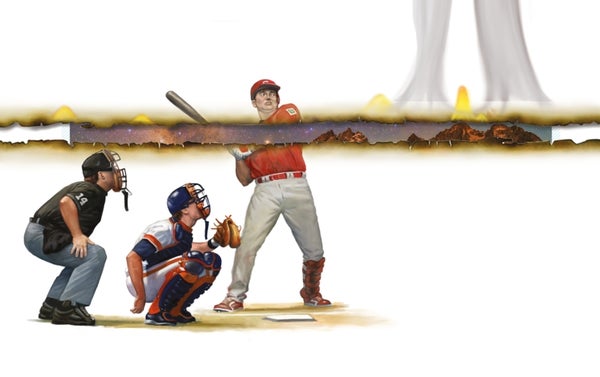
In the last area, many hitters swear that a really good fastball actually rises as it gets near them. Of course, the ball is still going down, because of gravity and air resistance, when delivered by any pitcher throwing overhand. That's just physics. The apparent rise compared with slightly slower pitches “is the difference between where [the hitter's] brain is telling him the ball is going to be and where it actually is when it approaches home plate,” explains Carnegie Mellon University physicist Gregg Franklin in the movie. That's just neuroscience.
But Bryce Harper of the Washington Nationals, winner of the 2015 National League Most Valuable Player Award, disrespectfully disagrees. “I think scientists are crazy if they think that,” Harper says in the movie. “I mean, Craig Kimbrel [Boston Red Sox closer]: it looks like his fastball rises every time he throws it. They need to grab a helmet, grab a bat and get in the box because they don't understand what's going on up there.” If any scientist interviewed for Fastball responded along the lines of “Harper needs to grab a calculus text and get in a Newtonian physics class before telling us that we don't understand what's going on up there,” it was left on the cutting-room floor.
As you'd expect, Fastball tries to determine who threw the fastest fastball. The zippiest pitch ever recorded by radar was thrown in 2010 by then Cincinnati Red and current New York Yankee Aroldis Chapman: 105.1 mph. The aforementioned Ryan, the all-time strikeout king (by a lot) with 5,714, became the first pitcher to have his fastball measured in an actual game by radar back in 1974. “The device was set up to measure his pitching speed about 10 feet in front of home plate,” physicist Franklin explains. “And he was actually clocked at 100.8 miles per hour.” Not in Chapman's league. Because it's probably better.
I did not know until I saw Fastball that in recent years pitch speed is measured 50 feet from home plate, “virtually the instant the ball leaves the pitcher's hand,” says narrator Kevin Costner, who caught “Nuke” LaLoosh's high hard ones in Bull Durham. That's where Chapman hit 105.1. Franklin, based on calculations perhaps scarier to Harper than a pitch near his chin, estimates that when Ryan's 1974 pitch was 50 feet from home it was traveling at better than 108 mph. “So we believe that once we make corrections,” Franklin says, “this is really the fastest pitch recorded.”
I'm reminded of a story, probably apocryphal, as it's told as having happened with everyone from Ryan to the first renowned fastballer, Walter Johnson, on the mound. The pitcher throws a fastball with such velocity that neither the batter nor the umpire even sees it. But the ump calls it a ball. Because, he explains, it “sounded high.” And, as Jeter would attest, like trouble.