
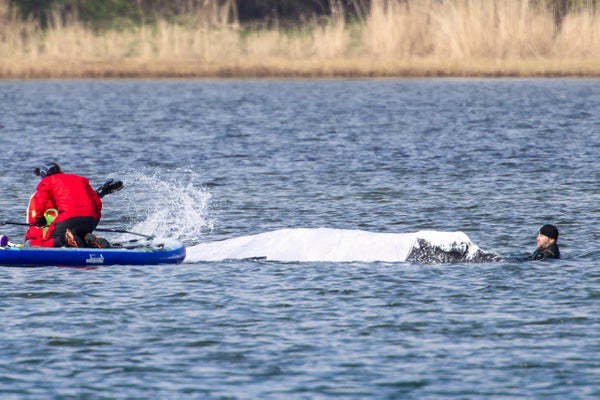
For more than a month, a humpback whale nicknamed Timmy has been stranded in the Baltic Sea off Germany. In early April rescuers called off the effort to save the creature, which had repeatedly become stuck on sandbanks and seemed in bad physical shape. But now, in a last-ditch attempt to save the whale, a team has loaded Timmy onto a specialized barge to essentially drag it to the North Sea. The International Whaling Commission, a global body that manages whale conservation, has called the effort “inadvisable.” Whether Timmy will survive is still uncertain, but some experts hope the story will inspire people to do more to protect whales.
“My guess would be that it’ll be a lot of effort, and the whale probably won’t survive,” says Matthew Savoca, a marine biologist at the California Marine Sanctuary Foundation. “But it’s cool to see people rally around a story that’s centered on a nonhuman animal.”
The saga of Timmy began on March 3, when the whale was first spotted off the German coast in the Baltic Sea. While humpbacks are found across the world’s oceans, they typically avoid shallow, low-salinity waters like those of the Baltic, so researchers suspect the whale became stranded because of illness, injury or disorientation.
On supporting science journalism
If you're enjoying this article, consider supporting our award-winning journalism by subscribing. By purchasing a subscription you are helping to ensure the future of impactful stories about the discoveries and ideas shaping our world today.
Initial rescue attempts were unsuccessful, and Timmy was expected to die while beached off the coast of a small Baltic island. Two German millionaires stepped in to back the latest attempt to save Timmy, however. On Tuesday divers loaded the whale onto a flooded barge that will carry it to the North Sea.
The whale was likely in a poor state of health when it first swam into the Baltic nearly two months ago. And since its stranding, the animal has reportedly been breathing irregularly and hardly moving.
The International Whaling Commission advocated against the recent rescue attempt, which it said was “well meant” but could cause an already ill animal more stress and “little ultimate benefit.” Still, the whale’s plight has captured imaginations, even inspiring protests in Germany to urge authorities not to give up on the animal.
“Something like this has never happened before in Germany, where a lifesaving operation of this kind has been carried out,” said Till Backhaus, a local official, at a press conference on Wednesday. “And this was an experiment, and the experiment was a success, and that’s wonderful.”
Still, Savoca says it’s likely that the whale will die soon after it arrives in the North Sea. But the experience of rallying around a whale could inspire people to focus on other issues affecting whales—such as injury by fishing gear and ship strikes.
“If we’re actually willing to dedicate this many resources, people power, funding and fuel to make this thing happen for this animal, imagine the type of conservation impact we can have on whole populations,” Savoca says.