
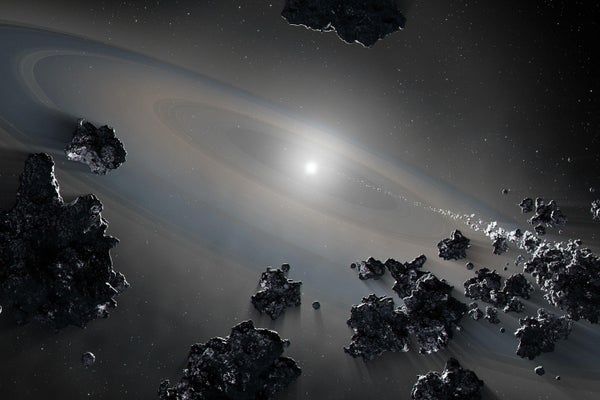
As the story of our cosmos moves forward, stars will slowly burn out, planets will freeze over, and black holes will devour light itself. Eventually, on timescales so long humanity will never witness them, the universe will fade into darkness.
But if you've ever wondered exactly when it all might end, you may find it oddly comforting, or perhaps a bit unsettling, to know that someone has actually done the math. As it turns out, this cosmic finale might arrive sooner than scientists previously thought.
Don't worry, though — "sooner" still means a mind-bending 10 to the power of 78 years from now. That is a 1 followed by 78 zeros, which is unimaginably far into the future. However, in cosmic terms, this estimate is a dramatic advancement from the previous prediction of 10 to the power of 1,100 years, made by Falcke and his team in 2023.
On supporting science journalism
If you're enjoying this article, consider supporting our award-winning journalism by subscribing. By purchasing a subscription you are helping to ensure the future of impactful stories about the discoveries and ideas shaping our world today.
"The ultimate end of the universe comes much sooner than expected, but fortunately it still takes a very long time," Heino Falcke, a theoretical astrophysicist at the Radboud University in the Netherlands, who led the new study, said in a statement.
The team's new calculations focus on predicting when the universe's most enduring celestial objects — the glowing remnants of dead stars such as white dwarfs and neutron stars — will ultimately fade away.
This gradual decay is driven by Hawking radiation, a concept proposed by physicist Stephen Hawking in the 1970s. The theory suggests a peculiar process occurs near the event horizon — the point of no return — around black holes. Normally, virtual pairs of particles are constantly created by what are known as quantum fluctuations. These particle pairs pop in and out of existence, rapidly annihilating each other. Near a black hole's event horizon, however, the intense gravitational field prevents such annihilation. Instead, the pair is separated: one particle, one carrying negative energy, falls into the black hole, reducing its mass, while the other escapes into space.
Over incredibly long timescales, Hawking's theory suggests this process causes the black hole to slowly evaporate, eventually vanishing.
Falcke and his team extended this idea beyond black holes to other compact objects with strong gravitational fields. They found that the "evaporation time" of other objects emitting Hawking radiation depends solely on their densities. This is because unlike black hole evaporation, which is driven by the presence of an event horizon, this more general form of decay is driven by the curvature of spacetime itself.
The team's new findings, described in a paper published Monday (May 12) in the Journal of Cosmology and Astroparticle Physics on Monday (May 12), offer a new estimate for how long it takes white dwarf stars to dissolve into nothingness. Surprisingly, the team found that neutron stars and stellar-mass black holes decay over the same timescale: about 10 to the power of 67 years. This was unexpected, as black holes have stronger gravitational fields and were thought to evaporate faster.
"But black holes have no surface," Michael Wondrak, a postdoctoral researcher of astrophysics at Radboud University and a co-author of the study, said in the statement. "They reabsorb some of their own radiation, which inhibits the process."
If even white dwarf stars and black holes eventually dissolve into nothing, what does that say about us? Perhaps it suggests meaning isn't found in permanence, but in the fleeting brilliance of asking questions like these — while the stars are still shining.
Copyright 2025 Space.com, a Future company. All rights reserved. This material may not be published, broadcast, rewritten or redistributed.