
When Russian troops invaded Ukraine in February, Iryna Stavchuk, like so many other Ukrainians, had her world turned upside down.
At the time, she was the deputy minister of environmental protection and natural resources and had been in the midst of working to help the country meet European standards on issues such as recycling and waste disposal. But when bombs began to fall on Kyiv, she immediately shifted her focus to emergency wartime operations.
Russian forces have since been driven out of the capital and the northern region of the country, and displaced people in some areas have begun to return to their homes. Though international attention on the fighting has waned, the battles have raged on in the industrial south and east and the environmental damage wrought by the war continues to mount.
On supporting science journalism
If you're enjoying this article, consider supporting our award-winning journalism by subscribing. By purchasing a subscription you are helping to ensure the future of impactful stories about the discoveries and ideas shaping our world today.
Before the war, Ukraine was a country beginning to make progress on environmental issues, Stavchuk says. It was modernizing the pollution-emitting factories that had made it an industrial center during the Soviet era. But those same industries have made the country more vulnerable to environmental damage under Russian attack. Scientific American spoke with Stavchuk, who left the ministry in May, about some of the major concerns she and others have about the war’s environmental toll.
[An edited transcript of the interview follows.]
In terms of environmental risks, what has scared you the most since the invasion began?
One of the biggest overall threats is that of nuclear accidents, and it has been very scary to observe the activities that were happening in Chernobyl and at the Zaporizhzhia nuclear power plant. The Russian army blocked electricity in Chernobyl, which controlled the radioactive-waste storage facility, and the whole [containment zone] also has its own monitoring system, which needs electricity.
In Zaporizhzhia, there was a fire in an administrative building. The Russians were killing the firefighters who were trying to stop the fire. They were using explosive weapons on the territory of the nuclear power plant, and those activities are extremely dangerous on radioactive sites.
Also, Ukraine is an industrial country, so we have a lot of industrial plants, big ones—chemicals, steel and others—which, in the case of military attack, can create huge local pollution.
And we have issues—which date from 2014, from the war in Donbas [the region in eastern Ukraine where Russia has supported separatist fighters]—related to attacks on the coal mines. There is an inability of coal mines to pump out water, and that leads to contamination of the underground water but also of the surface water. This water, which is highly polluted with different heavy metals and many other toxic compounds, is released and it then goes into rivers.
What is happening now with the Chernobyl and Zaporizhzhia plants?
The Zaporizhzhia nuclear power plant is under the control of the Russian army. There are representatives from the Russian nuclear power company Rosatom. The Ukrainian staff continues working at the plant but under the coordination and management of these Russian representatives of Rosatom. So basically, Rosatom is there to coordinate work, and we don’t have much information on that.
Regarding the Chernobyl exclusion zone, when Russian troops left, Ukraine took control of the territory, and they are now trying to estimate all the impacts. The system for the monitoring of radioactive pollution in the exclusion zone was damaged, and there were also damages to other systems. They’re now collecting all these facts to plan for how much money and resources are needed to rebuild.
What are some other ongoing issues you are concerned about?
I would say industrial disasters. There was one on April 9 in Luhansk [in the Donbas region]. It was a tank with four tons of nitric acid that was destroyed. And of course, there have been attacks on the oil depots. That also has substantial environmental impacts, especially on air pollution.
In terms of land pollution, we had two cases with poultry farms. When there is no electricity, it stops operation, and these chickens, they die very quickly. We don’t know how much [of the carcasses and other organic matter] was put into the fields. There’s the danger of bacterial contamination in groundwater.
What are some concerns with the fighting shifting to the southern and eastern parts of the country and with people beginning to return to their homes?
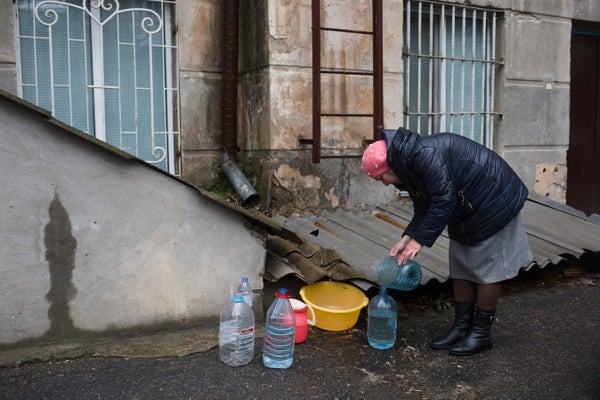
Drinking water in Ukraine is one of the targets of the occupiers, especially in the east and south. Russian troops are polluting fresh water by shelling plants and warehouses near water bodies, which can lead to leaks of hazardous substances. They have also destroyed water-treatment facilities. As a result of the hostilities, water infrastructure—including sewage-treatment facilities—are destroyed in almost all the cities of the Donetsk and Luhansk regions in the territories controlled by Ukraine [as of April].
In the south, the water supply from the Dnipro River to the city of Mykolaiv has been damaged. For over a month, the residents of Mykolaiv haven’t had [regular] access to clean water. [As of mid-April], data from UNICEF say 1.4 million people in Ukraine have no access to safe water, and 4.6 million have only limited access.
All these actions are causing irreparable damage to aquatic ecosystems and affect human health. This will be a growing issue as people begin to return to their homes. There is a fear that the destruction of the water system in places such as Mariupol’ could lead to the spread of infectious diseases, even cholera.
Politicians such as Boris Johnson have called for a major plan for rebuilding Ukraine. How should environmental concerns fit into such a plan?
Of course, we want that. It’s also been stated by our president that there’s a certain chance for Ukraine to rebuild its cities and industries with new green technologies and approaches that integrate energy efficiency and good planning for fewer emissions of greenhouse gases and also less pollution of the air. Good planning by itself actually contributes to better environmental results.