
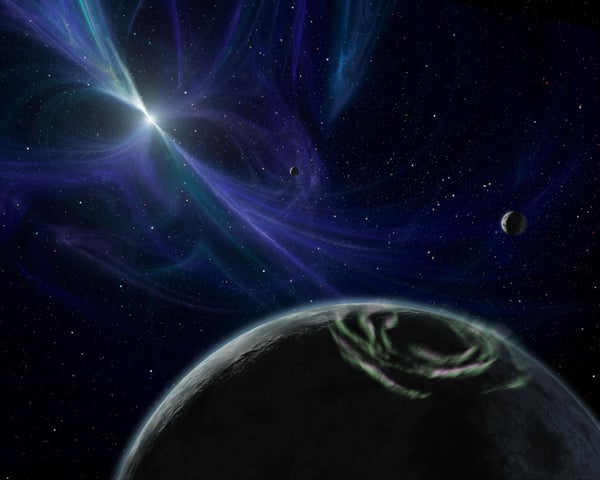
The exoplanet revolution began 25 years ago today.
On Jan. 9, 1992, astronomers Alex Wolszczan and Dale Frail published a paper in the journal Nature announcing the discovery of two planets circling an incredibly dense, rapidly rotating stellar corpse known as a pulsar.
It was a landmark find: While several alien-world "candidates" had recently been spotted, Wolszczan and Frail provided the first confirmation that planets exist beyond our own solar system. [Gallery: The Strangest Alien Planets]
On supporting science journalism
If you're enjoying this article, consider supporting our award-winning journalism by subscribing. By purchasing a subscription you are helping to ensure the future of impactful stories about the discoveries and ideas shaping our world today.
"From the very start, the existence of such a system carried with it a prediction that planets around other stars must be common, and that they may exist in a wide variety of architectures, which would be impossible to anticipate on the basis of our knowledge of the solar system alone," Wolszczan, who's based at Pennsylvania State University, wrote in a note about the pulsar planets for the "Name Exoworlds" contest sponsored by the International Astronomical Union.
The pulsar, called PSR B1257+12, lies about 2,300 light-years away from Earth, in the constellation Virgo. The two history-making planets, which Wolszczan and Frail detected using the Arecibo Observatory in Puerto Rico, are both about four times as massive as Earth. One takes 66 days to complete one lap around the pulsar, while the other's orbital period is 98 days.
Wolszczan and his colleague Maciej Konacki found a third planet orbiting the same pulsar in 1994. This world, which has a period of 25 days, is the least massive exoplanet known; it's just twice as hefty as Earth's moon.
These three strange worlds were long known as PSR1257+12b, PSR1257+12c and PSR1257+12d (with "b" being the innermost, "c" the middle and "d" the outermost planet). But the Name Exoworlds contest changed their official monikers to Draugr, Poltergeist and Phobetor, respectively, in 2015.
Another big milestone in exoplanet science came in October 1995, when Michel Mayor and Didier Queloz of the University of Geneva in Switzerland announced the discovery of the "hot Jupiter" 51 Pegasi b, the first alien planet known to orbit a sun-like star. And the finds have kept rolling in ever since.
The pace of discovery skyrocketed after the launch of NASA's Kepler space telescope in March 2009. Kepler detects exoplanets by noting the tiny brightness dips that orbiting planets cause when they cross their hosts stars' faces from the spacecraft's perspective. To date, Kepler has found 2,330 confirmed alien worlds using this "transit method"—about two-thirds of the 3,500-odd exoplanets known.
Kepler's observations also suggest that, on average, every star in the Milky Way galaxy hosts at least one planet. Furthermore, a sizable percentage of these trillion or so worlds are likely in their star's "habitable zone"—the just-right range of distances where liquid water could exist on a planet's surface.
So now, just a quarter-century after exoplanet science got its start, astronomers are racing to make epochal discoveries in the field—the first true "alien Earth," and, perhaps, evidence that our planet is not the only one that supports life.
Copyright 2016 SPACE.com, a Purch company. All rights reserved. This material may not be published, broadcast, rewritten or redistributed.