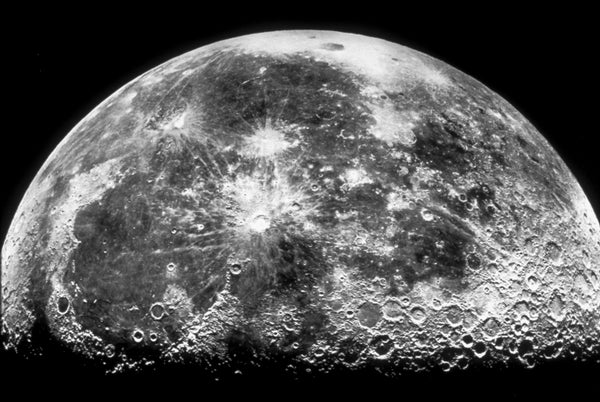
The Exploration of the Moon

The successful mission of Apollo 11 opens an epoch of manned lunar exploration. What questions should this exploration seek to answer, and what areas of the moon should be visited to best confront them?

Join Our Community of Science Lovers!

The success of the Apollo 11 mission in putting men on the moon and bringing them back safely with samples of lunar material marks the beginning of what promises to be a period of fruitful exploration of the moon by men and machines. The objective will be to answer a large number of questions about the origin and evolution of the moon, its geology, its chemical and physical structure and what light its history can shed on the history of other bodies in the solar system. Our purpose in this article is to discuss the major questions the coming manned expeditions to the moon will be taking up and to describe the techniques likely to be employed on such missions.

In an astronomical sense the moon is usually considered to be a satellite of the earth. From the viewpoint of planetary processes, however, the moon can be regarded as the smallest of the "terrestrial" planets (the others being the earth, Mars, Venus and Mercury). Because its distance from the sun is about equal to that of the earth, the moon is subject to external influences similar to those affecting the earth. The moon's smaller size, however, implies a history quite different from the earth's.

To continue reading this article, please download the PDF by clicking the link below.


On supporting science journalism

If you're enjoying this article, consider supporting our award-winning journalism by subscribing. By purchasing a subscription you are helping to ensure the future of impactful stories about the discoveries and ideas shaping our world today.


Download PDF

It’s Time to Stand Up for Science

If you enjoyed this article, I’d like to ask for your support. Scientific American has served as an advocate for science and industry for 180 years, and right now may be the most critical moment in that two-century history.

I’ve been a Scientific American subscriber since I was 12 years old, and it helped shape the way I look at the world. SciAm always educates and delights me, and inspires a sense of awe for our vast, beautiful universe. I hope it does that for you, too.

If you subscribe to Scientific American, you help ensure that our coverage is centered on meaningful research and discovery; that we have the resources to report on the decisions that threaten labs across the U.S.; and that we support both budding and working scientists at a time when the value of science itself too often goes unrecognized.

In return, you get essential news, captivating podcasts, brilliant infographics, can't-miss newsletters, must-watch videos, challenging games, and the science world's best writing and reporting. You can even gift someone a subscription.

There has never been a more important time for us to stand up and show why science matters. I hope you’ll support us in that mission.

Thank you,

David M. Ewalt, Editor in Chief, Scientific American

Subscribe